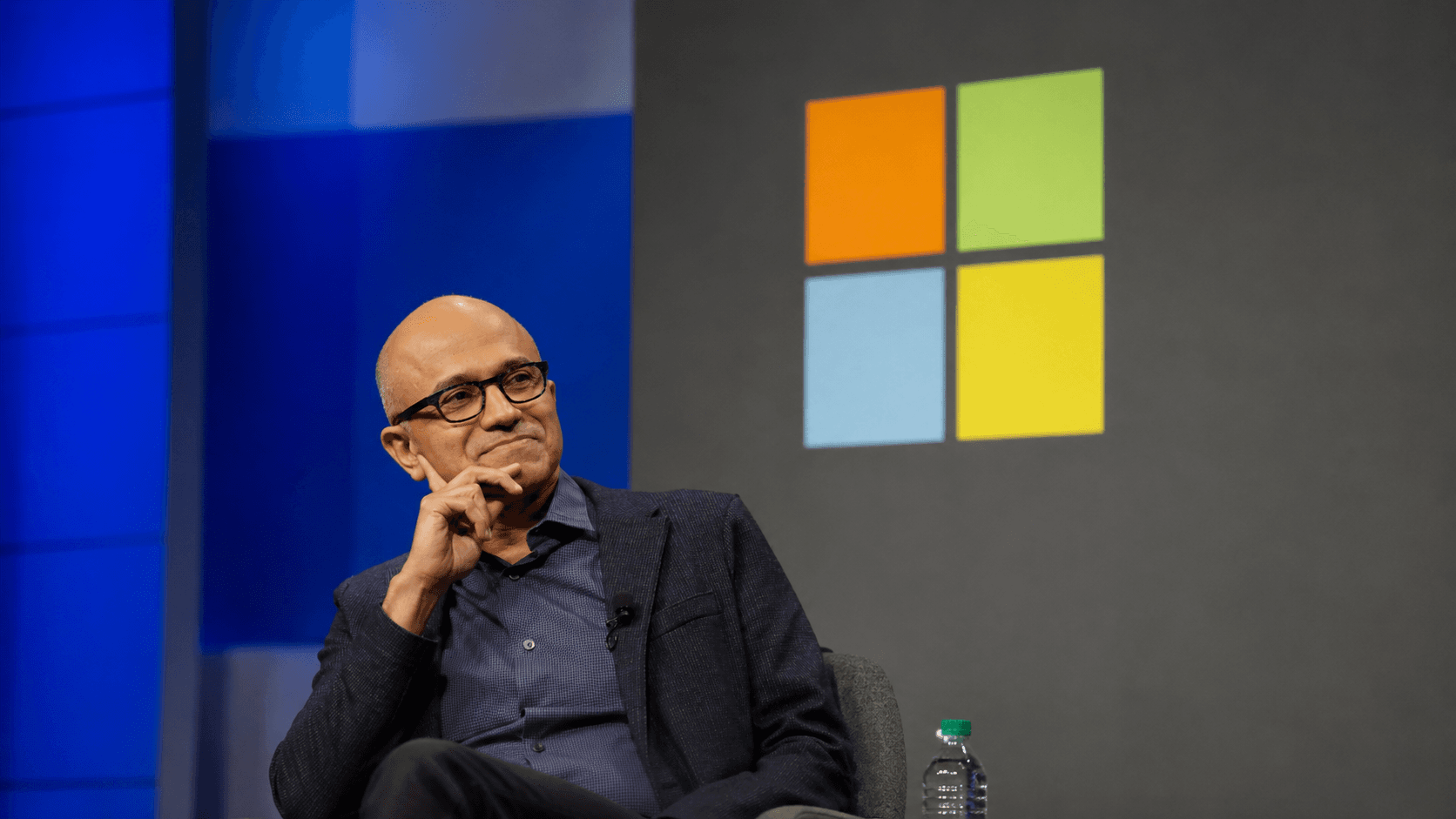
Satya Nadella used a Sunday appearance on CNN's Fareed Zakaria GPS to sharpen a warning he first delivered earlier this month: any enterprise that runs its AI stack entirely on a single proprietary lab is on borrowed time. The Microsoft CEO said companies without their own weights, their own gateways, and their own coding harnesses will eventually cease to be companies at all — because they will have handed the thinking part of the business to someone else.
Asked what counts as sharing too much with a model provider, Nadella pointed to almost everything: the prompts, the outputs, the metadata trail. He wants that data staying inside the enterprise, retained "so that you could use all of that to train perhaps your own weights or your own open model." Weights are a model's trained parameters — the brain itself. His argument is that customers should be accumulating the raw material to eventually build one.
The specific target of the warning is the coding harness — the wrapper around a model that manages context, memory, and tool use. Nadella named Anthropic's Claude Code and OpenAI's ChatGPT Codex as the harnesses enterprises are becoming dependent on. His prescription is to separate the harness, the context, and the memory from the model itself, so the model becomes a swappable component rather than the foundation of the whole operation.
Key facts
- 01Nadella told CNN's Fareed Zakaria GPS that enterprises relying entirely on proprietary AI labs won't survive as firms.
- 02He wants companies to keep the coding harness, context, and memory separate from the model itself.
- 03Microsoft is an investor in both Anthropic and OpenAI, the two AI labs whose harnesses — Claude Code and ChatGPT Codex — Nadella named as the tools to avoid depending on.
- 04In May, Sam Altman offered AI credits to every Y Combinator startup in the latest cohort, prompting Jason Calacanis to warn founders that OpenAI could copy their ideas.
- 05Nadella said the warning applies only to businesses, not to consumers, who trade data for free services.
That framing has an obvious commercial motive. Microsoft is an investor in both Anthropic and OpenAI, and coding agents are one of the most lucrative enterprise use cases for both. But Microsoft's cloud business is also selling exactly the kind of model-agnostic middleware Nadella is telling customers to buy. He is, in effect, telling enterprises to route around the two labs Microsoft has bankrolled — and to route through Azure instead.
The self-interest doesn't make the observation wrong. Enterprises are already asking for cheaper options, running open-weight models on their own hardware, and fine-tuning smaller systems for specific workloads. Managing multiple models requires an abstraction layer above any one provider, and coding agents that aren't chained to a single lab. The direction of travel is toward optionality; Nadella is simply naming it.
The deeper concern in Nadella's argument isn't cost — it's competitive risk. Once a company routes its internal workflows through a single lab's agent, that lab sees, in fine grain, what the company does and how it does it. Nothing structurally prevents the lab from turning around and offering a competing service built on that observation. The more agentic the deployment, the deeper the access, the sharper the risk.
This is the same fear the startup world has been voicing for years, now scaled up to the enterprise. Founders have long worried about building on a platform that could clone them. Nadella is telling Fortune 500 CIOs that the same dynamic now applies to them.
In May, when Sam Altman offered AI credits to every startup in the latest Y Combinator cohort, seed investor Jason Calacanis put the warning in blunter terms.
“If you take these tokens, there's a non-zero chance that OpenAI will study exactly what your startup is doing, copy your idea and put your app into their free offering. This is the classic platform playbook — be careful, founders!”— Jason Calacanis, Seed investor
Nadella carved out one exception: individuals. When Zakaria asked how everyday consumers should protect themselves, Nadella shrugged. "To some degree there's got to be some value exchange in the consumer space where you're getting something for free, maybe for your data. That's sort of how the advertising business model has worked," he said. The data-for-service bargain is fine for people; it is unacceptable for firms.
The distinction is coherent, if convenient. Consumer AI is a scale game where free products subsidized by data collection have worked for two decades. Enterprise AI is a moat game, and moats erode when the vendor also sells to your competitors — or becomes one.
Nadella's pitch lands at a moment when enterprises are still deciding whether AI is a utility they rent or a capability they build. If he is right, the winners of the next phase are the companies that treat models the way they treat databases — as commodities behind a stable interface — and the losers are the ones who let a single provider own the interface, the memory, and the workflow. That is a very good outcome for Azure's middleware business, and a very awkward one for the two labs Microsoft happens to fund.

Working on something we should cover, or seeing a story we missed? Send leads, documents, or feedback to hello@aichatdaily.com. For sensitive tips, see our secure tips page for Signal and PGP options.
Spotted an error? Email hello@aichatdaily.com with the URL and the issue, or read our full corrections policy.