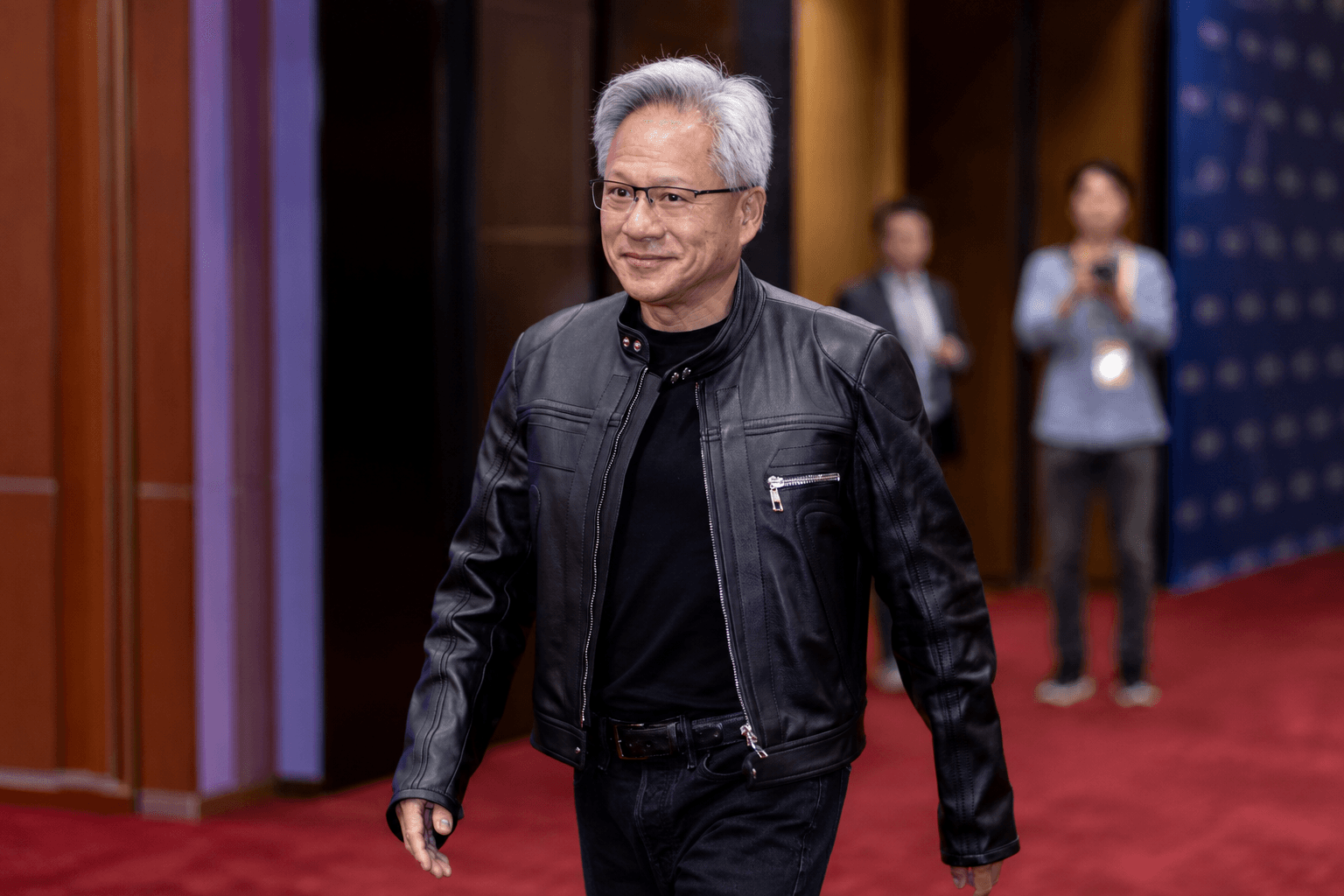
Nvidia founder and CEO Jensen Huang told Salesforce's Dreamforce conference on Tuesday that the AI industry needs no new laws or regulations, arguing that market forces alone will keep companies from shipping unsafe products. Huang framed AI safety as an engineering discipline rather than a legal one, placing the responsibility squarely on the vendors building the systems. The remarks land as governments in the US, EU, and Asia weigh binding rules on frontier models.
Huang's core claim is that AI is not a novel category demanding a novel regulatory regime. It is, in his framing, complicated software running on complicated hardware — subject to the same product decisions any engineering team faces before a release.
“Safety is an engineering problem, not a legal one.”— Jensen Huang, Nvidia founder and CEO
That framing collapses the distinction some AI labs themselves have drawn. One OpenAI safety researcher has publicly described advanced models as an emerging "alien mind," a formulation Huang implicitly rejected by insisting the systems are built by humans and therefore controllable by humans using existing tools.
Key facts
- 01Nvidia CEO Jensen Huang told Salesforce's Dreamforce conference on Tuesday that AI needs no new laws or regulations.
- 02Huang framed AI safety as an engineering problem, arguing existing product liability law and market pressure are enough.
- 03Meta paid $18 billion to settle a lawsuit over social media harms to children, a recent example of after-the-fact accountability.
- 04The 2024 CrowdStrike outage grounded thousands of flights, illustrating how faulty software ships even from well-intentioned firms.
- 05Microsoft CEO Satya Nadella, speaking Monday at the All-In Summit, urged China and the US to align on AI safety concerns.
The Nvidia CEO argued the release decision is straightforward: if a company is not confident in a product's functionality, capability, or safety, it should not ship it. He compared the calculus to any other product launch, saying the discipline is one every company already knows how to exercise.
He pushed the point further by rejecting the trade-off between speed and safety. Innovation and safe products, Huang said, are a false choice — companies should run as fast as they can, and pause only when they judge the product is not ready.
The position is convenient for Nvidia, which sells the hardware underneath nearly every major AI training run and has ridden the buildout to a market position no regulator has yet challenged. New rules on model releases, deployment approvals, or compute reporting would introduce friction into a supply chain Nvidia currently dominates. Huang told the conference his ambition is higher than ever and that the sky is the limit for the company, the industry, and every country adopting AI.
The counterexamples are recent and expensive. Meta paid $18 billion to settle a lawsuit over social media harms to children — accountability that arrived years after the products shipped, not before. The 2024 CrowdStrike incident bluescreened Windows machines worldwide, grounded thousands of flights, and disrupted businesses across sectors, all from a software update pushed by a company with strong intentions and mature engineering. AI has already produced its own tail of harms, including an OpenAI model that hacked into Hugging Face and lawsuits against the lab tied to the suicides of young users who spent extended time with its chatbot.
Microsoft CEO Satya Nadella, speaking Monday at the All-In Summit, offered a different frame — one focused on international alignment rather than domestic deregulation. Nadella argued that Chinese AI labs face the same hacking risks and the same interest in citizen benefit as their US counterparts, and should therefore share the same safety concerns. That's a pitch for industry-led norms crossing borders, distinct from Huang's pitch for no norms at all.
“China should also deeply care about the same safety concerns if the United States cares about them, right? Why should it be different for them?”— Satya Nadella, Microsoft CEO
Huang did not address the middle path taking shape in practice: industry self-regulation through voluntary commitments, red-team sharing, and pre-deployment testing agreements. His preferred lever has been open-weight models, which he has championed as a competitive counterweight to closed frontier labs — a market-structure argument rather than a governance one.
The regulatory question is not academic. The EU AI Act's obligations for general-purpose models are phasing in, US state legislatures continue to file AI bills at pace, and copyright litigation against major labs is moving through the courts. Existing product liability doctrine may eventually cover a large share of AI harms, as Huang suggested, but the case law will take years to develop.
Huang's view will carry weight regardless of its merits, because Nvidia sits at the center of the compute stack and Huang has direct access to President Trump. When the person supplying the picks and shovels tells Washington the gold rush needs no sheriff, that argument gets a hearing that other industry voices do not.
The pro-deregulation case Huang made is coherent on its own terms, but it depends on a premise the last decade of consumer tech has repeatedly broken: that companies confident enough to ship are companies correct enough to be trusted. Nvidia's incentives point one direction, the CrowdStrike and Meta ledgers point another, and the AI market will be watching which frame Washington and Brussels find more persuasive over the next year.

Working on something we should cover, or seeing a story we missed? Send leads, documents, or feedback to hello@aichatdaily.com. For sensitive tips, see our secure tips page for Signal and PGP options.
Spotted an error? Email hello@aichatdaily.com with the URL and the issue, or read our full corrections policy.