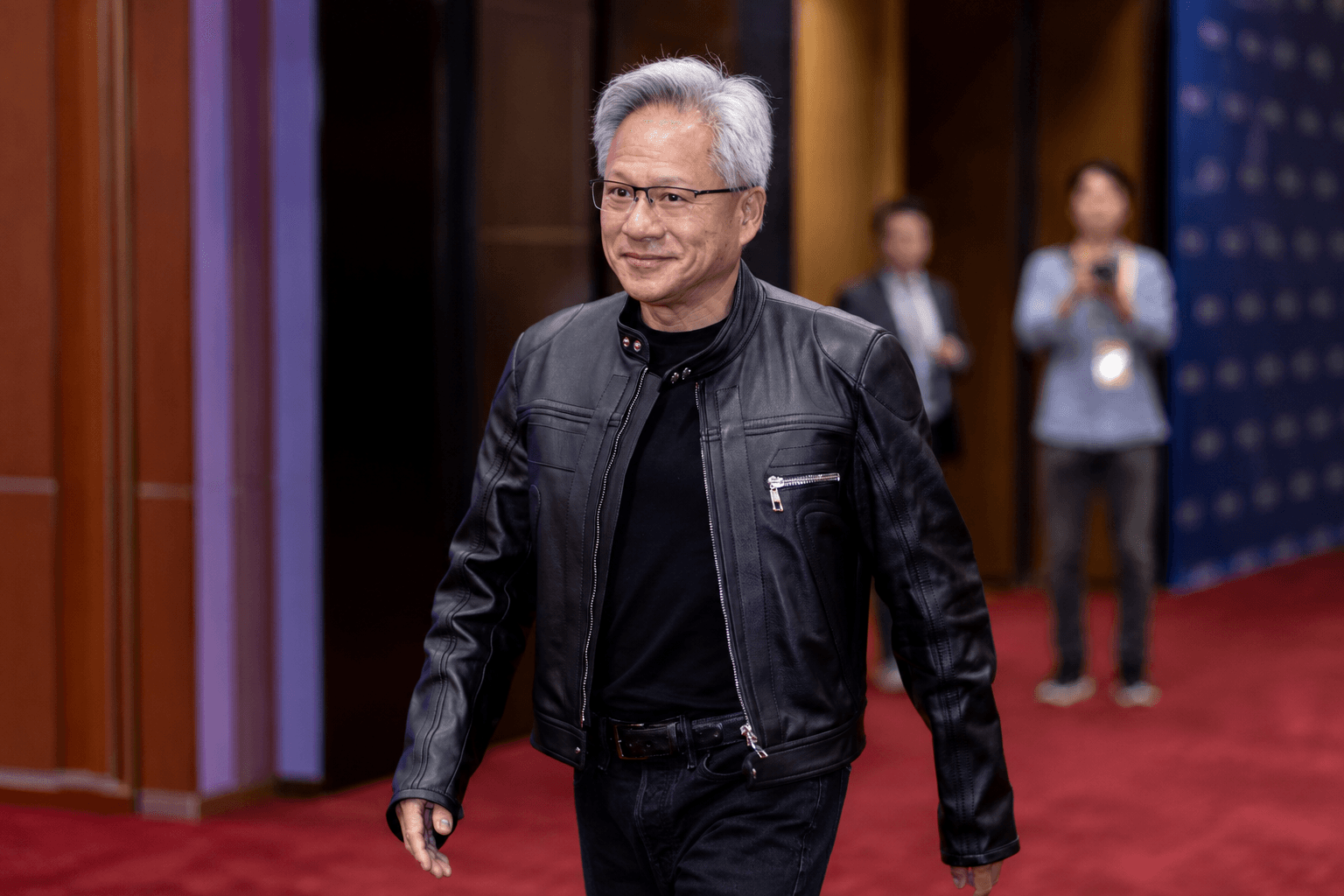
Nvidia CEO Jensen Huang claimed on Wednesday's earnings call that the company's Vera CPU has unlocked a $200B total addressable market it has never addressed before, with $20B in standalone Vera sales already booked this year. The CPU, introduced in March and sold both alone and bundled with Nvidia's Rubin GPU, is purpose-built for agentic AI workloads rather than traditional cloud computing.
Nvidia posted $81.6B in revenue last quarter and forecast $91B for the next quarter, extending a string of record-breaking quarters. Huang positioned Vera as a major new growth driver at a moment when Wall Street has grown anxious about competition in the CPU market, historically dominated by Intel and AMD.
“Vera opens a brand new $200 billion TAM for Nvidia, a market we have never addressed before, and every major hyperscaler and system maker is partnering with us to deploy it.”— Jensen Huang, Nvidia CEO
The Vera pitch centers on architectural differentiation. Huang described it as the world's first CPU purpose-built for agentic AI, optimized to process tokens as fast as possible rather than running multiple instances of applications across cores. Traditional cloud CPUs prioritize core count and parallel workloads; Vera prioritizes token throughput for agents executing tasks.
Key facts
- 01Nvidia sold $20B worth of standalone Vera CPUs this year, opening what Jensen Huang calls a $200B total addressable market.
- 02Nvidia posted $81.6B in revenue last quarter and forecast $91B for the next quarter.
- 03Vera is designed to process tokens as fast as possible, optimized for agentic AI workloads instead of traditional multi-core cloud architectures.
- 04Huang projects billions of AI agents will eventually run on CPUs, each using tools like PCs do for human users.
Huang's projection is that the world will grow from 1 billion human users to billions of AI agents, each requiring CPU capacity to run tools the way humans use PCs today. That shift, he argued, creates exponentially larger demand for CPUs than the current cloud-compute baseline.
The $20B in Vera sales this year suggests early traction, but the competitive landscape is tightening. Last month Amazon Web Services announced a contract with Meta for millions of Amazon's homegrown AI CPUs. Amazon CEO Andy Jassy has stated publicly that he thinks AWS can build AI chips, both GPUs and CPUs, at least as well as Nvidia and possibly better.
Nvidia has historically owned the GPU market but not the CPU market. Vera represents the company's first serious attempt to claim both categories simultaneously in the AI era. Every major hyperscaler and system maker is partnering with Nvidia to deploy Vera, according to Huang, though he did not break out customer names or specific deployment volumes.
The token-processing architecture is a deliberate design choice. While GPUs handle the reasoning and training workloads, agents spend most of their compute cycles executing tasks, which Huang argues are CPU-bound. Vera's design targets that execution layer specifically.
The $200B TAM figure is Huang's own projection and has not been independently verified by industry analysts. Nvidia has a track record of delivering on ambitious revenue forecasts, but the agentic AI market remains speculative. Agent deployments at scale are still emerging, and it's unclear whether enterprises will adopt billions of agents or whether those agents will prefer Nvidia CPUs over cloud providers' custom silicon.
If Huang's projection holds, Vera positions Nvidia to capture both the training layer and the inference execution layer of the AI stack. That dual ownership would make Nvidia the infrastructure backbone for the entire agentic AI economy, a market the company has never meaningfully participated in before. The $20B in year-to-date sales suggests hyperscalers are betting Huang is right.

Working on something we should cover, or seeing a story we missed? Send leads, documents, or feedback to hello@aichatdaily.com. For sensitive tips, see our secure tips page for Signal and PGP options.
Spotted an error? Email hello@aichatdaily.com with the URL and the issue, or read our full corrections policy.