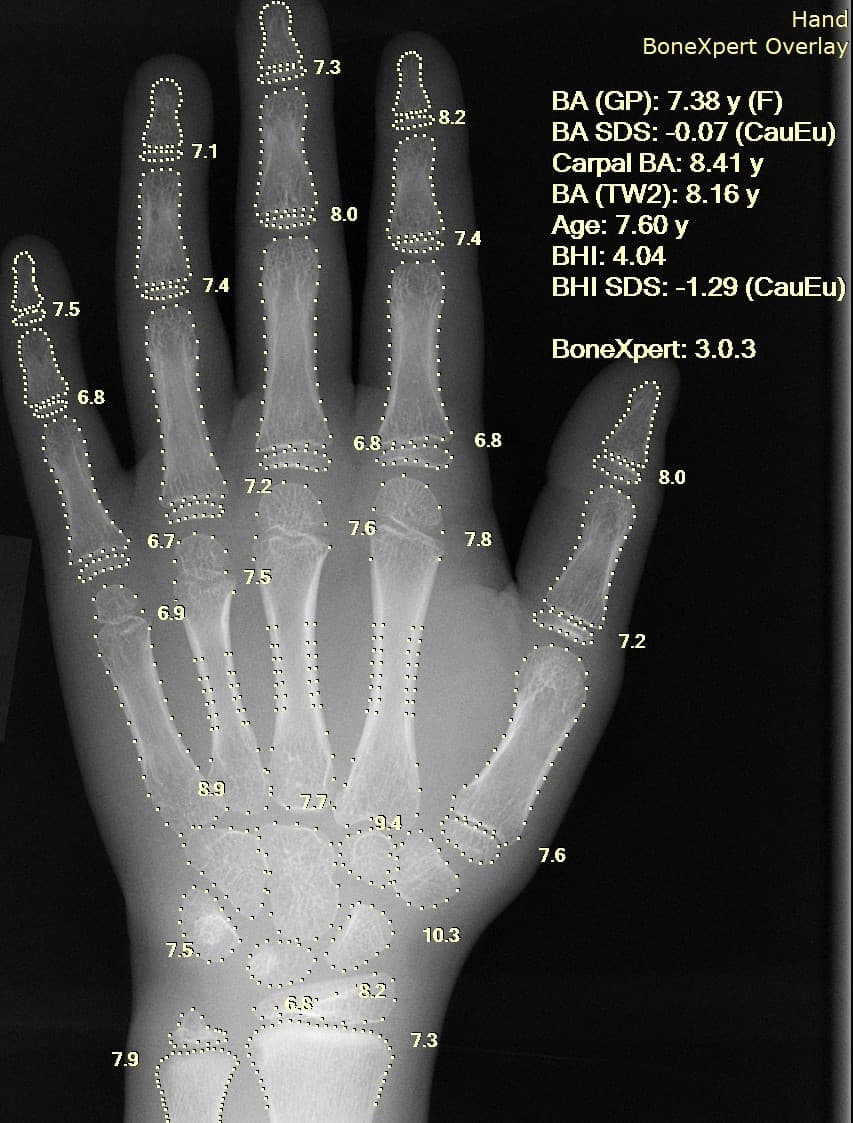
The number of practicing radiologists is projected to grow 26 percent over the next three decades, even as the Food and Drug Administration has cleared roughly 1,400 AI-enabled medical devices as of early 2026, with three-quarters of them aimed at radiology. Ten years ago, Geoffrey Hinton predicted the specialty would be gone by 2021. Instead, radiology has become medicine's most active proving ground for expert AI systems, and the humans are still hiring.
The share of AI devices concentrated in imaging makes radiology a bellwether for how expert decision-making software gets absorbed into a licensed profession. Some tools draft preliminary reports or triage urgent scans. Others outperform trained physicians at specific detection tasks, including one meta-analysis of 43 clinical trials that concluded AI-assisted colonoscopies identify more polyps than conventional procedures.
The accuracy stakes are large. Human error rates on diagnostic images run 3 to 5 percent on average, which translates to roughly 40 million errors worldwide each year. Closing that gap is the argument for aggressive AI deployment. The counter-argument, from the radiologists themselves, is that the machine's mistakes are different from the human ones, and dropping the human out of the loop trades one error pattern for another.
“This requires a whole mental rewiring”— Paul Yi, Section chief of intelligent imaging informatics at St. Jude Children's Research Hospital
Key facts
- 01The FDA has cleared roughly 1,400 AI-enabled medical devices as of early 2026, with three-quarters targeting radiology.
- 02Radiologist headcount is projected to grow 26% over the next three decades, contradicting Geoffrey Hinton's 2016 prediction.
- 03Human diagnostic image error rates run 3 to 5 percent, translating to about 40 million errors worldwide each year.
- 04An AMA survey found 25% of physicians received no AI training and only 11% received a lot.
- 05A meta-analysis of 43 clinical trials found AI-assisted colonoscopies detect more polyps than conventional procedures.
Curtis Langlotz, who directs the Center for Artificial Intelligence in Medicine and Imaging at Stanford University, uses a hypothetical lung nodule detector to make the point. Assume it catches 95 percent of nodules on a chest CT while radiologists catch 90 percent. The naive read is that the machine wins.
Langlotz argues the radiologist still catches part of the 5 percent the machine misses, because human and machine intelligence fail on different inputs. That framing — humans as the second reader who spots the AI's specific blind spots — is now the working model for radiology AI deployment. It also inverts the old assumption that automation removes the human; here, the human's job shifts to auditing a mostly-correct machine.
The mental adjustment is not trivial. Paul Yi, section chief of intelligent imaging informatics at St. Jude Children's Research Hospital in Memphis, Tennessee, describes it as a rewiring. Physicians already override rule-based electronic medical record alerts about half the time, but those alerts show their reasoning. Modern radiology AI runs on neural networks that do not, which makes deciding when to veto the machine harder than deciding when to veto a drug-interaction warning.
Charles Kahn, editor of Radiology: Artificial Intelligence at the Radiological Society of North America, frames the reader's dilemma: is a flagged region a real abnormality, or is the AI seeing something the human missed? Two well-documented cognitive biases push in opposite directions. Automation bias leads radiologists to accept AI calls too readily, including false positives. Automation complacency leads them to accept clean AI reads too readily, missing false negatives such as intracranial blood on a CT.
Nina Kottler, chief medical AI officer at Mosaic Clinical Technologies, argues the fix is monitoring the disagreement rate between radiologist and machine over time and intervening when it drifts. If a radiologist accepts the AI's call 99 out of 100 times against a tool with 95 percent accuracy, that gap is a training signal, not a productivity win.
“If radiologists are accepting the AI result 99 out of a hundred times and we know it's only 95 percent accurate, we go talk to that rad”— Nina Kottler, Chief medical AI officer of Mosaic Clinical Technologies
Training is the weak link. A 2026 American Medical Association survey found that more than a quarter of physicians had received no AI training at all, and only 11 percent said they had received a lot. Kottler notes that generic accuracy figures are also insufficient — a radiologist needs to know, for example, that a given tool is wrong on roughly 30 percent of scans when the patient moved in the scanner. Failure modes matter more than headline accuracy.
Kottler also argues AI tools should surface a per-case confidence estimate rather than a binary call, since no radiologist can memorize the failure profile of every system in the department. That request lands on vendors: the current generation of FDA-cleared devices largely ships binary outputs, and calibrated uncertainty is not the default.
The counterweight to all of this is that human oversight only works if the human is genuinely engaged. One study cited by Langlotz found experienced radiologists' mammography accuracy dropped substantially when they read under the influence of incorrect AI predictions. If the second reader learns to defer, the second reader is no longer a second reader. That is the risk the deployment models are trying to design around, and it is not yet solved.
The takeaway for the broader AI market is that radiology is the clearest working example of a regulated, licensed profession where AI is not a jobs story — it is a workflow story. FDA clearances measure supply, not substitution, and the specialty is hiring while it integrates. The companies building vertical AI for medicine, law, and finance should study the radiology curve: the winning products are the ones that make the licensed professional faster and more accurate, ship calibrated confidence, and give the buyer a defensible audit trail. The ones that pitch replacement keep losing to the ones that pitch a second reader.

Working on something we should cover, or seeing a story we missed? Send leads, documents, or feedback to hello@aichatdaily.com. For sensitive tips, see our secure tips page for Signal and PGP options.
Spotted an error? Email hello@aichatdaily.com with the URL and the issue, or read our full corrections policy.