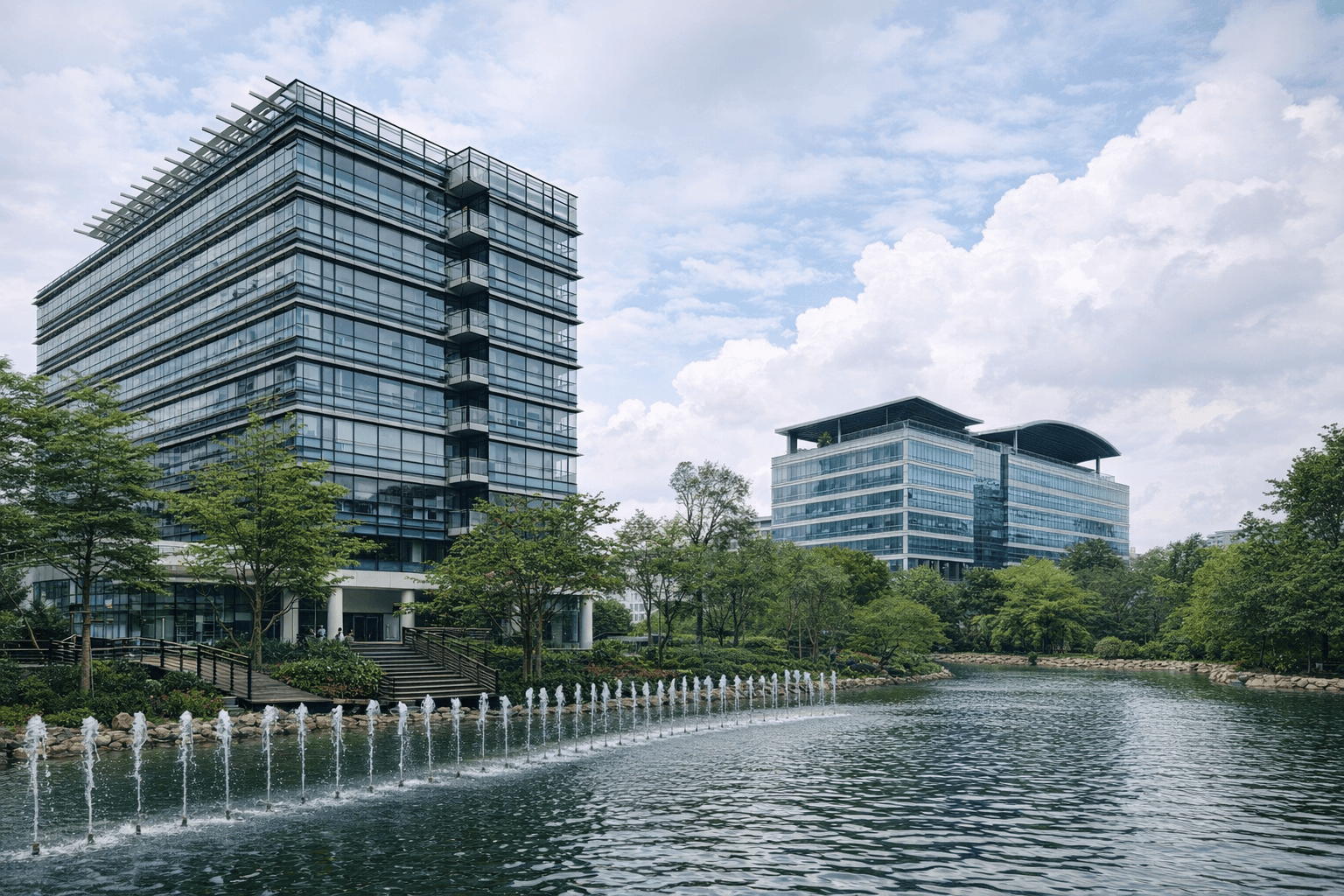
Lam Research will spend more than $3 billion expanding its research and development laboratories, a bet that the next wave of chipmaking tools will need to be invented, not iterated. The Fremont-based equipment maker sells the etch, deposition, and cleaning systems that fabs use to build advanced logic and memory chips — including the accelerators powering every frontier AI model in production today. The $3 billion R&D commitment lands at a moment when the industry's capacity constraints have moved upstream, from finished chips to the tools that make them.
Lam Research is one of the four companies that effectively decide how fast the semiconductor industry can advance, alongside ASML, Applied Materials, and Tokyo Electron. Its equipment is embedded in every leading-edge fab operated by TSMC, Samsung, Intel, SK Hynix, and Micron. When Lam's R&D roadmap slips, so does the industry's node cadence — and with it the supply of the GPUs and high-bandwidth memory that AI labs are buying by the tens of billions of dollars each quarter.
The $3 billion figure is meaningful in context. Lam's total annual R&D spend has historically run around $1.8 billion to $2 billion, so a multi-billion dollar lab expansion represents a step-change in physical research capacity rather than a routine budget increase. The company is choosing to build new experimental fab space and tool development lines rather than simply hire more engineers into existing facilities.
Key facts
- 01Lam Research committed more than $3 billion to expand its R&D lab footprint.
- 02The investment targets next-generation chipmaking equipment as AI accelerator demand strains fab capacity.
- 03Lam sits alongside ASML, Applied Materials, and Tokyo Electron as one of the four dominant wafer fab equipment suppliers.
The motivation is straightforward. AI accelerators are the highest-margin, fastest-growing segment of the semiconductor market, and building them requires increasingly exotic process steps — gate-all-around transistors, backside power delivery, high-numerical-aperture EUV integration, and the advanced packaging that stitches compute dies together with high-bandwidth memory. Each of those transitions demands new etch chemistries, new deposition recipes, and new metrology, all of which have to be developed and qualified before a fab customer will commit to buying tools at volume.
High-bandwidth memory is a particularly sharp pressure point. HBM stacks sit next to every leading AI GPU, and the packaging processes that bond those stacks — hybrid bonding, through-silicon vias, advanced wafer thinning — sit squarely in Lam's addressable market. Micron and SK Hynix have both signaled that HBM demand is sold out through 2026, and the equipment makers who supply their capacity expansions are the direct beneficiaries.
Lam's chip-equipment peers are moving in the same direction. Applied Materials has been expanding its EPIC research center in Silicon Valley, and ASML continues to pour money into high-NA EUV development in the Netherlands. The competitive dynamic is that no equipment vendor can afford to fall a generation behind on process development — customers standardize on tools years before a node ramps to volume, and losing a design-in at TSMC or Samsung means losing a decade of revenue on that node.
The geopolitical backdrop matters too. US export controls have carved off China as a market for the most advanced Lam tools, but domestic and allied fab construction — Arizona, Ohio, Texas, Japan, Germany — has created a parallel wave of demand. The CHIPS Act and equivalent European and Japanese subsidies are financing fabs that will need to be equipped, and Lam's R&D expansion positions the company to supply the tools those fabs will need in 2027 and beyond.
The risk is timing. Semiconductor equipment is famously cyclical, and Lam is committing capital based on a demand forecast that assumes AI infrastructure spending continues to grow at its current pace. If frontier model training economics soften — if inference-time compute proves cheaper than expected, or if a generation of accelerators lasts longer in production than modeled — the fab buildout could slow and equipment orders with it. Lam's bet is that the R&D investment pays off across multiple demand cycles, not just this one.
For the AI industry specifically, moves like this are a reminder that the compute supply chain runs much deeper than Nvidia and TSMC. Every capability roadmap at OpenAI, Anthropic, Google, and Meta ultimately depends on whether Lam Research and its three peers can ship tools that let fabs build denser, faster, more power-efficient chips on schedule. A $3 billion R&D lab expansion is a leading indicator that the equipment tier believes AI-driven demand is durable enough to underwrite a decade of fundamental process research — and that's a more confident signal about the AI infrastructure cycle than any single hyperscaler capex announcement.

Working on something we should cover, or seeing a story we missed? Send leads, documents, or feedback to hello@aichatdaily.com. For sensitive tips, see our secure tips page for Signal and PGP options.
Spotted an error? Email hello@aichatdaily.com with the URL and the issue, or read our full corrections policy.