XDOF emerged from stealth today with $70 million in funding to sell frontier AI labs the one thing they can't easily build in-house: high-fidelity robot training data. The round was led by Thrive Capital with participation from Spark Capital, a16z, Lux, and WndrCo. XDOF already has 60 employees and 20 customers, including several frontier labs its co-founder and CEO Philipp Wu declined to name.
The timing tracks a sharp pivot at the top of the AI industry. OpenAI said two weeks ago it would relaunch the robotics program it shut down in 2021, joining a field where every major lab is now chasing physical AI. The bottleneck is no longer compute or model architecture — it's data that captures real-world physical interaction, which barely exists at the scale language models trained on.
“All of the top labs are trying to pursue robotics”— Philipp Wu, XDOF co-founder and CEO
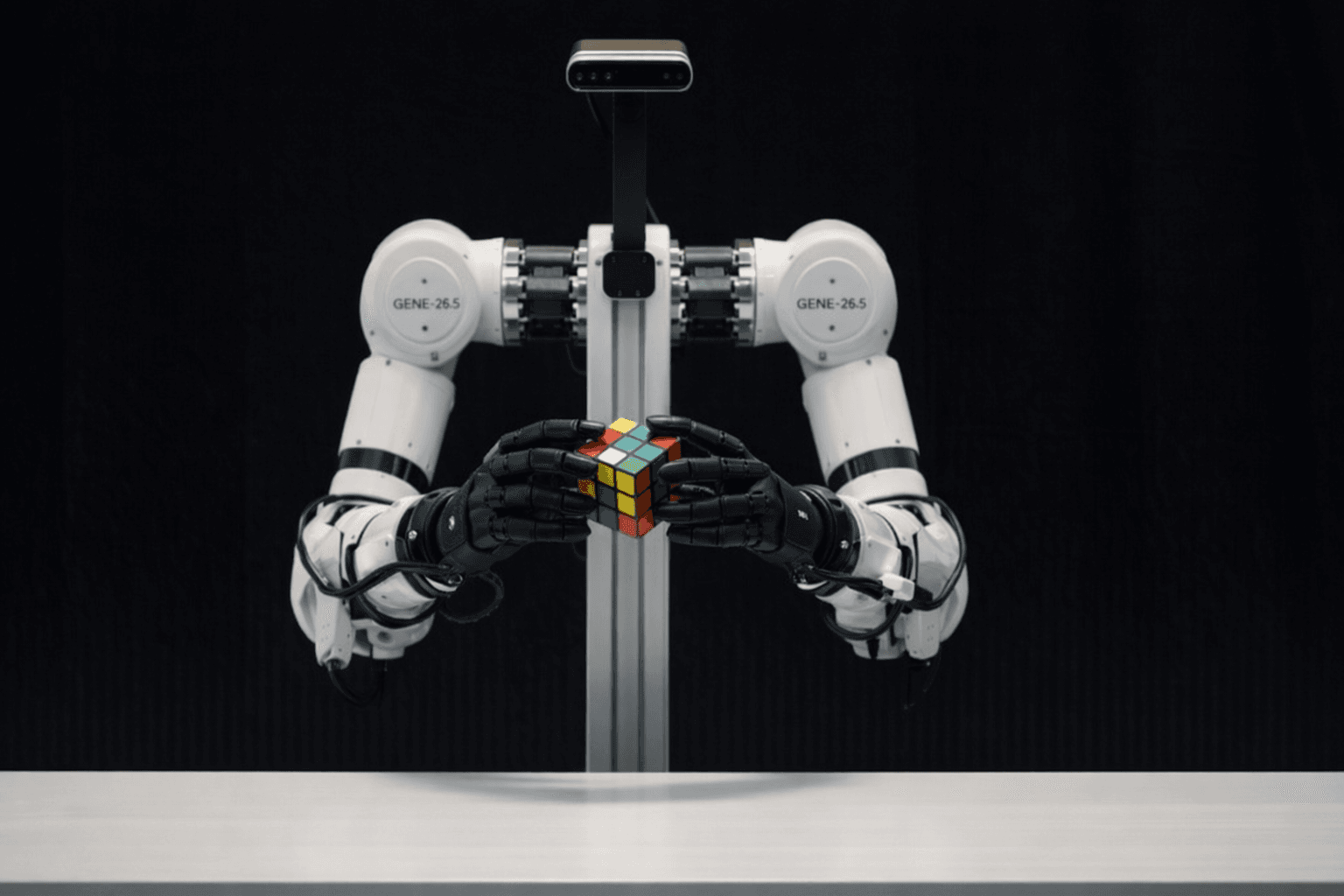
YouTube footage and gig-worker video are too low-fidelity to teach a robot how to fold a shirt or load AirPods into a case. XDOF is betting the next infrastructure layer of AI is the pipeline that produces, cleans, and annotates the data robots actually need. The company plans to operate across three tiers: teleoperation data captured on the exact robot being deployed, more general teleoperated data, and egocentric data from humans wearing XDOF's own planned sensors.
Key facts
- 01XDOF raised $70M from Thrive Capital, Spark Capital, a16z, Lux, and WndrCo to build robot training data infrastructure.
- 02The startup has 60 employees and is already working with 20 customers, including several unnamed frontier AI labs.
- 03XDOF and UC Berkeley are releasing ABC, a dataset of 130,000 robot manipulation trajectories, 300 hours of simulation, and 100 hours of evaluations.
- 04OpenAI relaunched its robotics program two weeks ago, five years after shuttering it in 2021.
- 05Figure AI's latest humanoid robot has 30 degrees of freedom, compared to seven in a human arm.
Wu hit the data wall himself as a UC Berkeley PhD student trying to train robots on large-scale datasets that didn't exist. He and future XDOF CTO Fred Shentu built GELLO, a low-cost teleoperation rig that lets a human puppet a robot arm to generate training data. The paper became influential precisely because the rest of the field had the same gap.
Wu, Shentu, and COO Nemo Jin launched XDOF in October 2024 to turn that approach into a business. The company is deliberately bundling data collection with cleaning, tooling, and annotation, since pure data provision tends to become a commodity. The pitch to frontier labs is a self-reinforcing feedback loop they can plug into rather than rebuild.
“There was this chicken-and-egg problem — we first needed to actually collect data before we could even ask how to train a foundation model for robotics.”— Philipp Wu, XDOF co-founder and CEO
As a proof of scale, XDOF is partnering with UC Berkeley's AI Research lab to release ABC, what the team calls the largest collection of high-quality robot training data ever assembled. It includes 130,000 trajectories of robot manipulation, 300 hours of simulation, and 100 hours of evaluations. David McAllister, a Berkeley PhD student who helped organize the release, said the open release should let the academic community produce results comparable to what happened when language and image datasets went public.
The obvious question is why frontier labs don't run this operation themselves. Wu's answer is operational: producing useful robot data requires warehouses, fleets of robots that need calibration and maintenance, and trained teleoperators distributed at scale. "You need to maintain these robots, calibrate their physical parameters, and properly train operators," he said. It's a labor- and capex-heavy buildout that AI labs would rather outsource to a specialist.
“You need a warehouse of hundreds of thousands of square feet with hundreds of robots”— Philipp Wu, XDOF co-founder and CEO
Hardware design choices feed back into data quality in ways that matter. "Your camera choice is going to affect the quality of your data — which is going to affect how your hand-tracking algorithm performs," Wu said. "If you don't design the hardware well from the start, the data you collect might have very specific problems that you didn't anticipate." XDOF is planning to staff teleoperator and egocentric data teams globally.
The company name is a play on degrees of freedom, the robotics term for independent axes of motion. A human arm from shoulder to wrist has seven; Figure AI's latest humanoid has 30. Wu describes XDOF's ambition as "arbitrary degrees of freedom, unlimited degrees of freedom" — a pitch aimed squarely at labs building toward general-purpose humanoids rather than single-task arms.
The skeptical read is that XDOF is taking on a labor-intensive business with thin defensibility. Teleoperator armies and annotation pipelines have been commoditized before in computer vision, and the customer concentration risk is real when a handful of frontier labs account for most demand. If OpenAI, Figure, or a humanoid leader decides to verticalize data collection — as several have signaled in adjacent areas — XDOF's moat narrows to whatever proprietary hardware and tooling it can ship faster than its buyers.
The bet that makes XDOF interesting is structural. Robotics foundation models are roughly where language models were before the Common Crawl era, and whoever owns the data layer during that gap captures outsized leverage. This release also lands alongside Genesis AI's Eno humanoid debut and a wave of physical-AI capital, which we've covered over the past two weeks. If physical AI follows the LLM playbook, the picks-and-shovels providers — XDOF among them — will be priced like infrastructure long before any single robotics model wins.

Working on something we should cover, or seeing a story we missed? Send leads, documents, or feedback to hello@aichatdaily.com. For sensitive tips, see our secure tips page for Signal and PGP options.
Spotted an error? Email hello@aichatdaily.com with the URL and the issue, or read our full corrections policy.