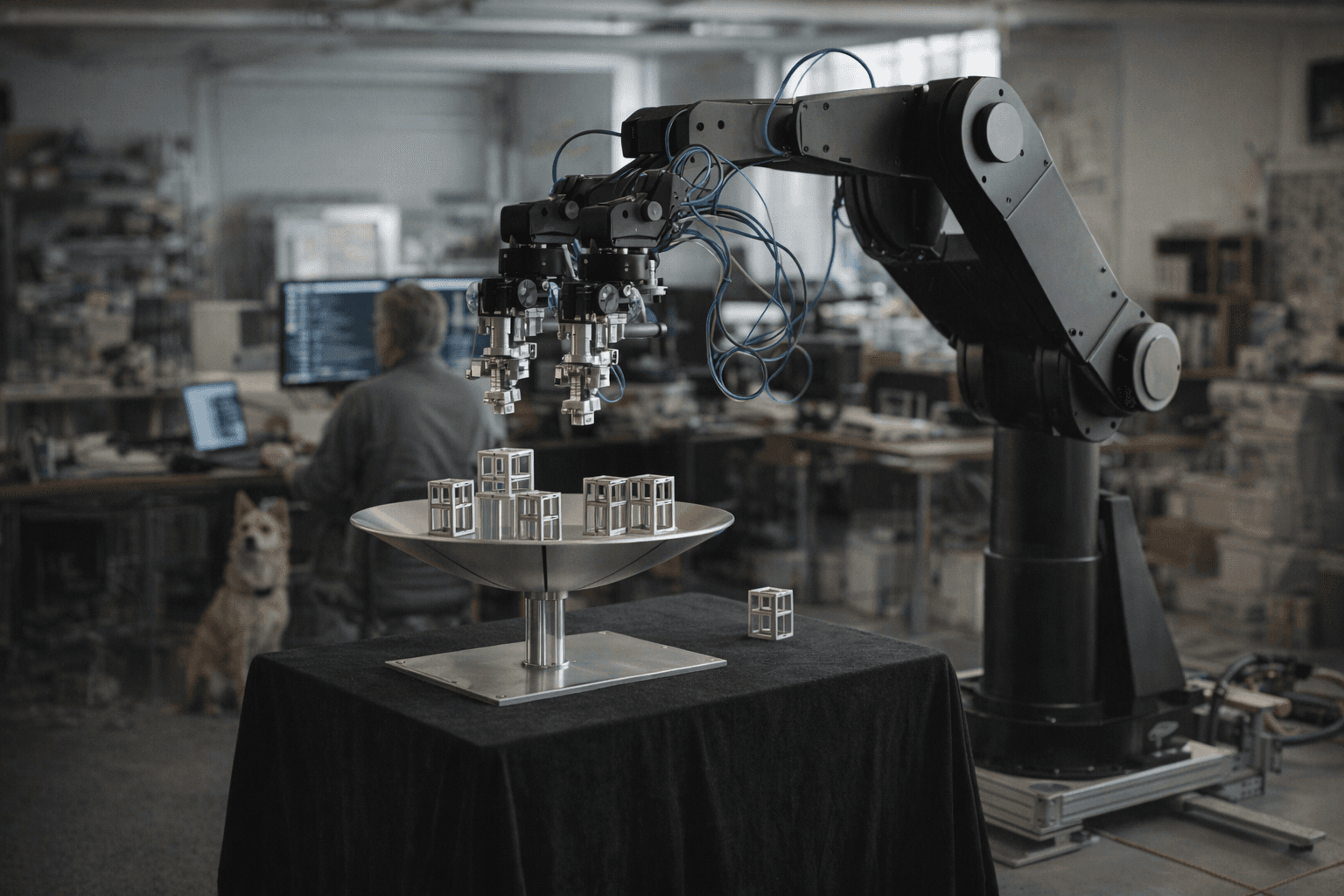
Sony AI's table tennis robot, called Ace, has become the first known autonomous machine to defeat elite and professional-level human players in real matches, according to research the company published on the cover of Nature this month. The result pushes robotics into a domain long considered a benchmark for human reflexes, where rallies are decided in fractions of a second.
The headline metric is speed. Ace plans and executes its shots inside a window tight enough to keep up with players whose careers are built on muscle memory honed over years of training. "AI is now hitting professional human performance in tasks that require, you know, sub 200 millisecond planning loops," Jaeden Schafer said on the podcast, framing the Nature cover as another data point in a broader pattern of machines closing in on expert humans.
Table tennis is a deliberately hard test bed. The ball moves quickly, spin and angle change shot to shot, and the margin for error on the paddle face is small. Human pros do not consciously calculate any of it. As Schafer put it on the show, "this is happening with muscle memory, with years and years of training," which is precisely what makes a robot reproducing that performance from sensors and code notable.
Key facts
- 01Sony AI's Ace robot is the first known autonomous machine to beat elite, professional-level human table tennis players in real matches.
- 02The research appeared on the cover of Nature, one of science's top journals, this month.
- 03Ace operates with sub-200 millisecond planning loops, the speed required to track and return shots from professional opponents.
- 04Sony's result lands as humanoid robotics broadens into elder care, household help and other physical tasks beyond sport.
Sony AI's project sits in a wider race among technology companies to prove that machine learning can drive physical systems, not just text and image generation. Robotics has historically lagged software because the real world is unforgiving on latency, calibration and recovery. A win against professional table tennis players is a way of showing investors and researchers that the perception-to-action loop is finally tightening.
“AI is now hitting professional human performance in tasks that require, you know, sub 200 millisecond planning loops.”— Jaeden Schafer
Schafer was careful not to oversell the sport itself as economically important. "This is not, you know, something that has a big impact on society, ping pong, the ping pong industry," he said, while conceding the line would irritate competitive players. The point of the demonstration is the underlying capability, not the game.
That capability is what the rest of the industry will try to transplant. Schafer pointed to humanoid robots as the obvious next frontier, with potential roles helping aging parents stay in their homes, reaching items off high shelves or assisting someone who has fallen. He acknowledged the discomfort some readers feel about that future, but argued there are real use cases in settings where human help is hard to find.
For Sony, the Nature cover is also a branding moment. The company is better known to consumers for cameras, PlayStation and entertainment than for frontier AI, and Sony AI has been steadily building a research profile in games and now physical control. Putting Ace on the cover of one of science's most-cited journals stakes a claim that its lab belongs in the same conversation as the larger US-based AI groups.
The broader signal is that the boundary between specialist human skill and machine performance keeps moving. Schafer closed by saying he is "really impressed with what Sony AI has done" and expects more results in the same vein. If sub-200 millisecond control loops generalize beyond a ping pong table, the industries that get reshaped will not be sport.

Working on something we should cover, or seeing a story we missed? Send leads, documents, or feedback to hello@aichatdaily.com. For sensitive tips, see our secure tips page for Signal and PGP options.
Spotted an error? Email hello@aichatdaily.com with the URL and the issue, or read our full corrections policy.