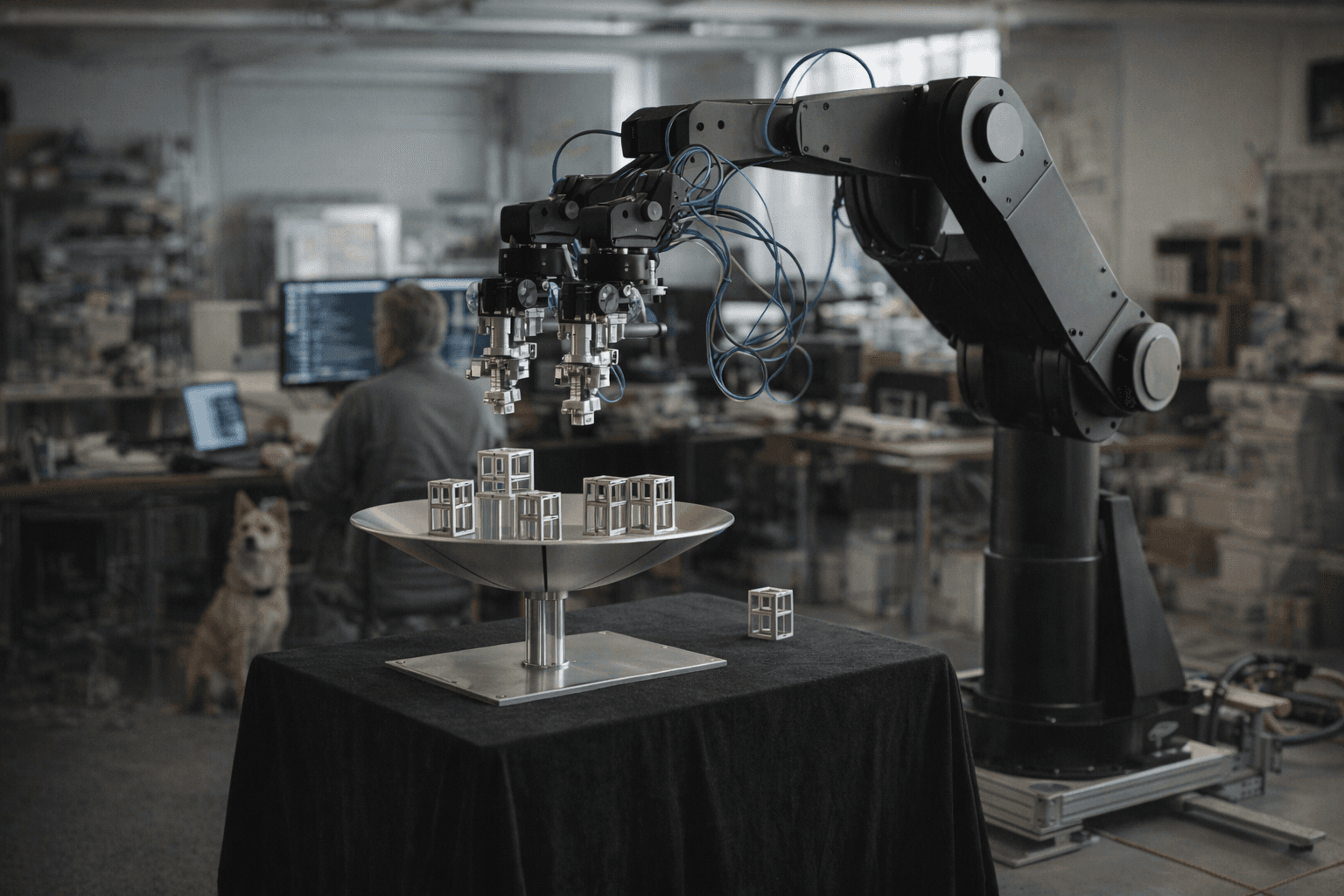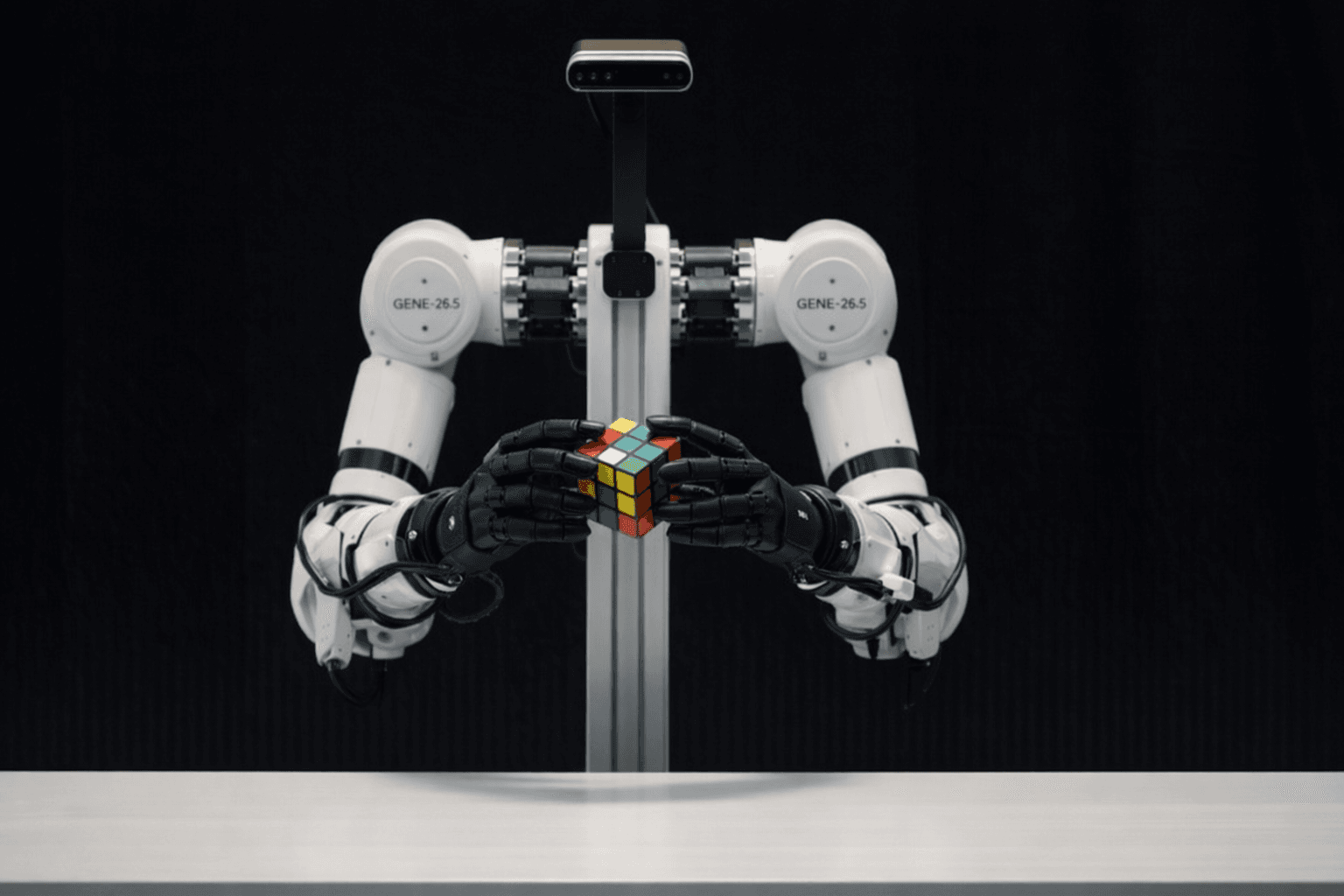
Hello Robot released the fourth iteration of its home-assistance robot Stretch last month at $30,000, with the first manufacturing run of 200 to 300 units already sold out from its Martinez, California headquarters. The company sits 45 miles north of Silicon Valley both geographically and philosophically: while rivals chase humanoid form factors and foundation-model promises, Hello Robot ships a wheeled robot with a telescoping arm and a pair of pinchers that is already living in real homes. The bet is that deployment beats demos.
Founded in 2017 by CEO Aaron Edsinger, a former director of robotics at Google, and CTO Charlie Kemp, a professor at the Georgia Institute of Technology, Hello Robot is not building a foundation model or claiming Stretch will replace every human job. Stretch 4 has a vaguely human torso, a sensor-studded head, and an omnidirectional wheeled base. When its batteries run down, the lights around its eyes glow red. "It looks angry," jokes Blaine Matulevich, an engineer at the company.
The pricing matters. At $30,000, Stretch 4 costs slightly more than comparable robots from Chinese manufacturers, but Edsinger notes those frequently ship without sensors or software, add-ons that ultimately push the total higher. One non-obvious design constraint: Stretch has to fit in a cardboard box shippable via UPS or DHL. The moment wooden crates and on-site installation teams become necessary, the cost curve breaks and accessibility for researchers, hackers, and disability-services buyers collapses with it.
Key facts
- 01Hello Robot released Stretch 4 last month at $30,000, with 200 to 300 units planned at its Martinez, California headquarters and the first run sold out.
- 02Founded in 2017 by ex-Google robotics director Aaron Edsinger and Georgia Tech professor Charlie Kemp, the company targets real homes rather than humanoid moonshots.
- 03Board member Keith Platt, quadriplegic since 2021, cut a protein-shake task from nearly two hours to a few minutes using Stretch.
- 04Rival 1X says it sold out the 10,000 Neo humanoids planned for this year, but has yet to deliver any.
- 05Stretch ships in a cardboard box via UPS or DHL — a design constraint to avoid the cost spiral of crates and installation teams.
Keith Platt, an investor in Georgia who now sits on Hello Robot's board, became quadriplegic in 2021 and began working with the company in 2024. He controls his Stretch through a voice-operated iPhone app, dispatching it autonomously around his house before taking direct control for object manipulation. One project — getting Stretch to serve him a protein shake for breakfast, a task that normally requires another person — became a measurable proof point.
Platt called the regained independence "huge" and predicted such systems would be "life-changing" for families if robotic assistants let people with mobility challenges safely spend a day at home alone. Stretch ships with limited autonomy by design; keeping a human in the loop is the point. Matulevich frames the choice plainly: being in control is a feature people want embodied in the robot. Platt adds a practical benefit — he doesn't worry about Stretch tipping over if it suffers an error, because it doesn't have legs to fall on.
That contrasts sharply with the humanoid push dominating Bay Area robotics. 1X drew significant attention last year for Neo, a humanoid robot people could buy for in-home chores; the company says it sold out the 10,000 Neos planned for this year, but none have been delivered. The Bot Company, another San Francisco humanoid contender, is being sued by an Airbnb owner who says the company rented his apartment to develop its robot, which then scratched furniture, broke appliances, and chipped bathroom tiles.
Hardware remains the unsolved problem. Robotic arms still weigh substantially more than human limbs, requiring high-energy active balancing, and physics is unforgiving when something goes wrong. Mahi Shafiullah, a postdoc working on robotic hands at the University of California, Berkeley, recalled industrial robots in his lab accidentally punching through a plastic kitchen play set they were supposed to manipulate carefully. He used the third-generation Stretch during his PhD research at New York University; models developed on it won the best demonstration prize at last year's Computer Vision and Pattern Recognition conference.
The deployment-first thesis is gaining institutional backing. Bullhound Capital wrote in a sector report published last week that "companies that deploy first accumulate site-specific recovery loops and workflow tolerances that no competitor can buy or synthesize," arguing that in robotics the moat is accumulated operating hours under real-world liability, not just intellectual property. The data problem is the binding constraint: simulation is improving, but it isn't producing the messy, multi-surface, multi-lighting interaction logs that home robots actually need.
“The algorithms may be there, but the data is not, and data is actually really like 80% ingredient that matters”— Mahi Shafiullah, postdoc at the University of California, Berkeley
Edsinger compares Hello Robot's positioning to Waymo, which became the leading self-driving operator by leading on safety rather than scale promises. Hello Robot's customer mix already spans three buyer types: academic researchers testing increasingly sophisticated AI controllers, enterprise customers piloting Stretch in settings like data centers, and accessibility specialists building in-home aides for people with disabilities. The company keeps an occupational therapist on staff to support work with users like Platt.
The skeptical view is that a $30,000 wheeled robot with pinchers will look modest if a humanoid manufacturer actually delivers a capable bipedal unit at consumer scale. Nvidia and Unitree's recent Thor-chip humanoid blueprint and the ongoing 1X production push suggest the humanoid camp is not slowing down, and the data advantage Hello Robot is accumulating only matters if home-collected manipulation data transfers cleanly to whatever form factor wins. Stretch's wheeled base also limits the environments it can serve — stairs remain a hard boundary.
Hello Robot's quieter pitch is that physical AI advances are bottlenecked on data, not algorithms, and the only way to get that data is to put robots into homes that don't have safety crews on standby. A $30,000 unit that fits in a UPS box, doesn't fall over, and earns its keep helping a quadriplegic user drink a protein shake is a more credible data-collection platform than a humanoid that exists mainly in promotional video. If the deployment-moat thesis holds, the company that ships 300 working robots this year may end up better positioned for the home market than the one that promised 10,000 and shipped zero.

Working on something we should cover, or seeing a story we missed? Send leads, documents, or feedback to hello@aichatdaily.com. For sensitive tips, see our secure tips page for Signal and PGP options.
Spotted an error? Email hello@aichatdaily.com with the URL and the issue, or read our full corrections policy.