Genesis AI has raised $500 million in a Series A round led by Khosla Ventures, Premji Invest and Eclipse, giving the robotics startup fresh capital to move its Eno robot from a few dozen units toward mass production and paying customers.
The raise follows a $105 million seed round from Eclipse and Khosla announced in July 2025. Genesis AI was co-founded in 2024 by CEO Zhou Xian and president Théophile Gervet, who met as graduate students in a Carnegie Mellon University lab.
Genesis AI builds a physical AI model that runs on robot hardware. Its flagship robot, Eno, is a wheeled machine designed to look like an iMac on wheels, and the company's robot hands are built to mimic human hand proportions. Zhou says Genesis AI has cracked dexterous manipulation.
Key facts
- 01Genesis AI raised a $500 million Series A led by Khosla Ventures, Premji Invest and Eclipse.
- 02The round follows a $105 million seed round announced in July 2025.
- 03The company has built 30 to 40 of its Eno robots and picked a contractor to begin US mass manufacturing next year.
- 04Training data comes from sensor-enabled gloves worn by more than 100 workers around the world.
- 05Genesis AI says it plans to begin targeted customer deployments by the end of 2026.
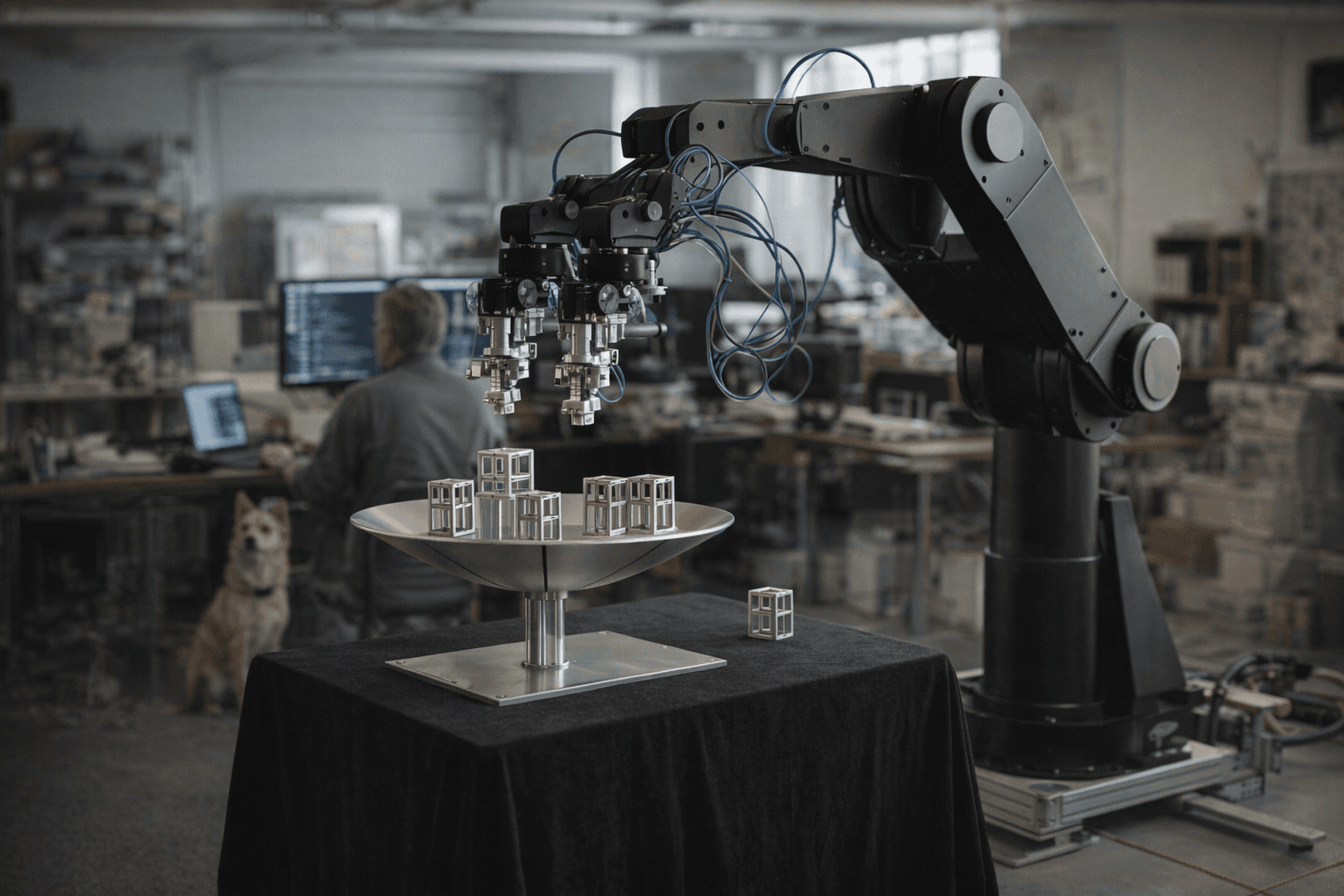
At its Silicon Valley facility, the company demonstrated its model running on two off-the-shelf robotic arms that packed boxes, taped one shut and applied a shipping label. The company is pursuing vertical integration, building the model, the robot and the data pipeline itself.
“We wanted to ship the best robot, end-to-end product”— Zhou Xian, CEO and co-founder of Genesis AI
That data pipeline centers on a sensor-enabled glove worn by more than 100 workers around the world, paired with headset cameras that record the tasks they perform. Genesis AI also builds its own generative AI model and physics simulation; adviser Minchen Li co-authored the IPC physics algorithm the company draws on.
Zhou argued that the model design is a small part of the result, estimating that architecture contributes maybe 10% while training infrastructure, data infrastructure and data quality drive the rest. He said he does not expect the company to need another fundamental scientific leap.
“No, we have all the recipes. It's just about execution.”— Zhou Xian, CEO and co-founder of Genesis AI
On hardware, Genesis AI has built 30 to 40 Enos so far. The design for the mass-produced version is finalized, and the company has chosen a contract manufacturer to begin mass production in the US next year.
Durability remains an open engineering problem across the field: Genesis AI's dexterous hands currently last a few weeks of regular work before they need replacing. The company competes with humanoid makers including Figure and Agility.
Genesis AI is piloting its robots with a handful of undisclosed customers and says on its website that it plans to begin targeted customer deployments by the end of 2026.

Working on something we should cover, or seeing a story we missed? Send leads, documents, or feedback to hello@aichatdaily.com. For sensitive tips, see our secure tips page for Signal and PGP options.
Spotted an error? Email hello@aichatdaily.com with the URL and the issue, or read our full corrections policy.