Gritt exited stealth Tuesday with $34 million in total funding, including a fresh $26 million Series A led by Obvious Ventures, to deploy AI-controlled robots on solar construction sites. The Carnegie Mellon-founded startup says an eight-person crew paired with its system installs 3,000 to 4,000 panels a day, versus 800 for the same crew working manually. Union Square Ventures and Active Impact Investment joined the Series A; First Round Capital, Climactic, Congruent Ventures, and VSC Ventures backed an earlier seed.
The company is already contracted to help install 2.8 gigawatts of solar panels over the next 18 months, and counts three of the top 10 US power construction firms as customers. Two Gritt systems are running in the field today, and the company is targeting 48 deployed systems within six months. That ramp is the operational bet behind the round: the AI improves as the fleet grows, and the fleet grows as customers see the throughput math.
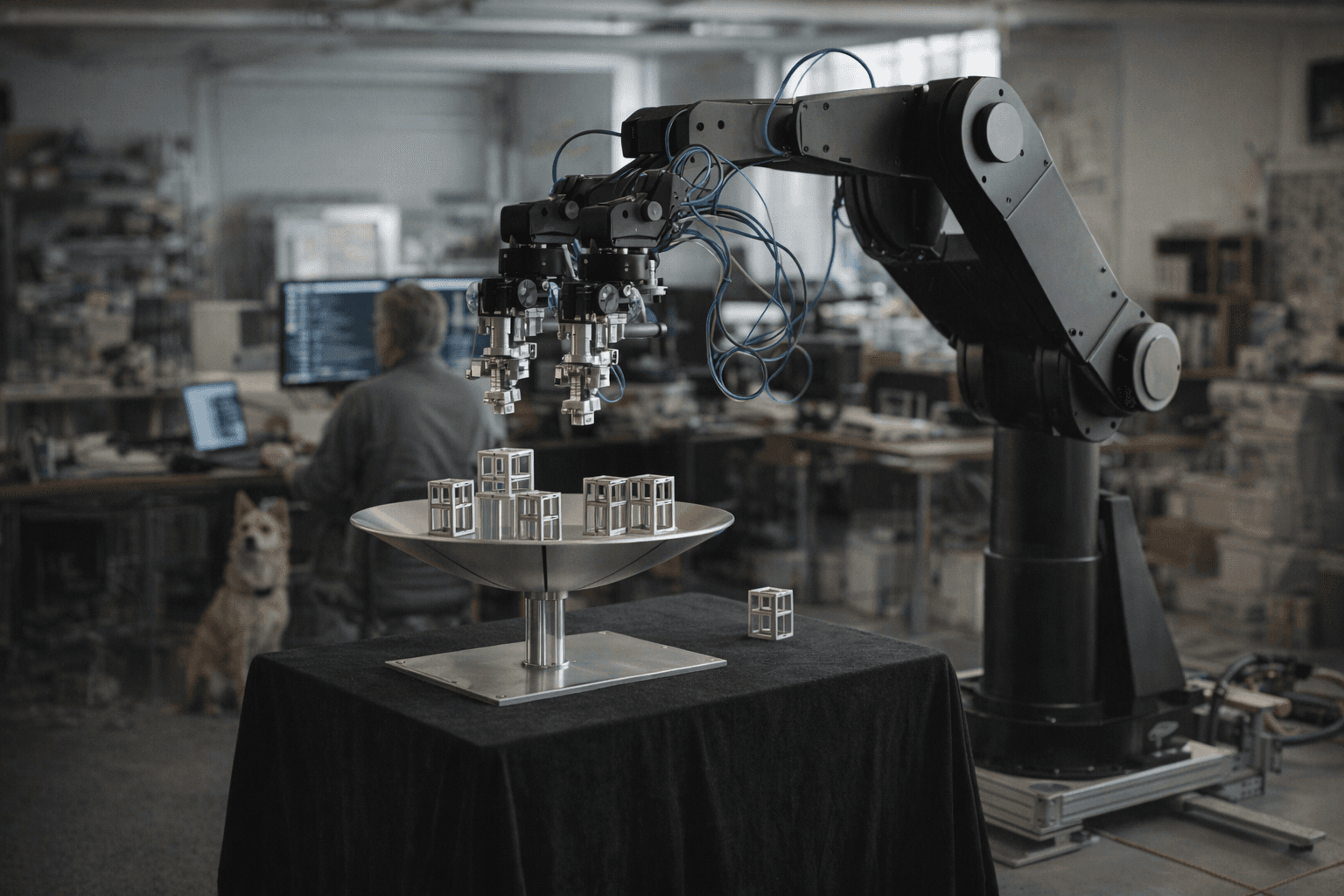
Gritt was co-founded by CEO Puneet Puri and CTO Vishal Dugar, both trained at Carnegie Mellon. Rather than build proprietary hardware, the company rents off-the-shelf skidders and robotic arms — Kawasaki is one supplier — and layers its own AI models on top to handle the perception, planning, and manipulation work.
“you need an intelligence which can work in the outdoor, chaotic environments of these construction sites, and it has to be generalizable enough that it can work in these varied environments.”— Puneet Puri, Gritt CEO
Key facts
- 01Gritt raised a $26M Series A led by Obvious Ventures, bringing total funding to $34M.
- 02Crews using Gritt's systems install 3,000–4,000 solar panels a day, up from 800 without them.
- 03The company is contracted to help install 2.8 gigawatts of solar in the next 18 months.
- 04Three of the top 10 US power construction firms are already Gritt customers.
- 05Gritt aims to run 48 systems within six months, up from two deployed today.
The first job the system handles is the most physically punishing one on a utility-scale solar site: unloading 100-pound glass panels, carrying them to the racking, and setting them on the metal frames with sub-millimeter accuracy so a human crew can fasten them. One Gritt customer, who spoke to the primary reporter on the story on condition of anonymity, said the system makes remote sites more staffable and should reduce injuries from workers lifting heavy panels overhead all day.
Andrew Beebe, the Obvious Ventures partner who led the round, framed the pitch as classic dirty-jobs scaling with modern AI on top.
The competitive field is filling in fast. Luminous Robotics, Cosmic, and China's Trinabot are all chasing panel-installation robotics, but those companies are building their own hardware end-to-end. Gritt's off-the-shelf approach is a bet that the value is in the models and the data, not in reinventing the arm — a leaner cost structure if the software generalizes, a weaker moat if it doesn't.
Puri argues that generalization is exactly what the current AI stack now enables. He said training the system to stack cinder blocks took weeks, while a comparable demo with rebar tying took a single day on the same software pipeline. That reuse is the roadmap: fasten the panels, drill the posts, build the racks, and eventually tie rebar before a concrete pour — all common labor-intensive tasks on any large construction site.
The founders also see the sensor suite doing more than manipulation. Cameras and models already on-site can flag missing inventory, spot an open trench before a storm rolls in, or alert supervisors to conditions that would otherwise cost a day of rework.
“Gritt becomes now this layer of physical AI, which is doing this dextrous, labor-intensive task, plus it can help you take decisions on the site.”— Puneet Puri, Gritt CEO
The counterweight is execution risk. Gritt is running two systems today and needs to hit 48 in six months while its customers scale gigawatts of installs on tight schedules. Outdoor construction is where industrial robotics has historically failed — dust, weather, uneven terrain, and human crews in the loop — and rented hardware means Gritt is exposed to the reliability of arms and skidders it doesn't fully control. Luminous, Cosmic, and Trinabot, all building bespoke rigs, are betting the vertical stack matters.
For the AI market, Gritt is a data point that physical AI is starting to earn revenue in industries where labor supply, not model quality, is the binding constraint. US solar deployment is capped in part by how many people can be trained to install panels in the sun for eight hours; a system that quadruples per-crew throughput changes the unit economics of every gigawatt contracted this decade. If Gritt's software genuinely generalizes from panels to posts to rebar, the company is less a solar robotics vendor and more a horizontal construction-automation layer — which is a much larger market than the one that funded it.

Working on something we should cover, or seeing a story we missed? Send leads, documents, or feedback to hello@aichatdaily.com. For sensitive tips, see our secure tips page for Signal and PGP options.
Spotted an error? Email hello@aichatdaily.com with the URL and the issue, or read our full corrections policy.