Maven Robotics exited stealth today with $100 million in funding and eight robots already running 16-hour shifts at customer facilities with 99% or higher uptime. The Santa Clara startup, led by former Apple engineer Hamza Derbas, plans to build 250 third-generation robots and begin designing a fourth-generation platform. RoboStrategy, LocalGlobe, Vine Ventures, and XTX Markets Ventures led the round.
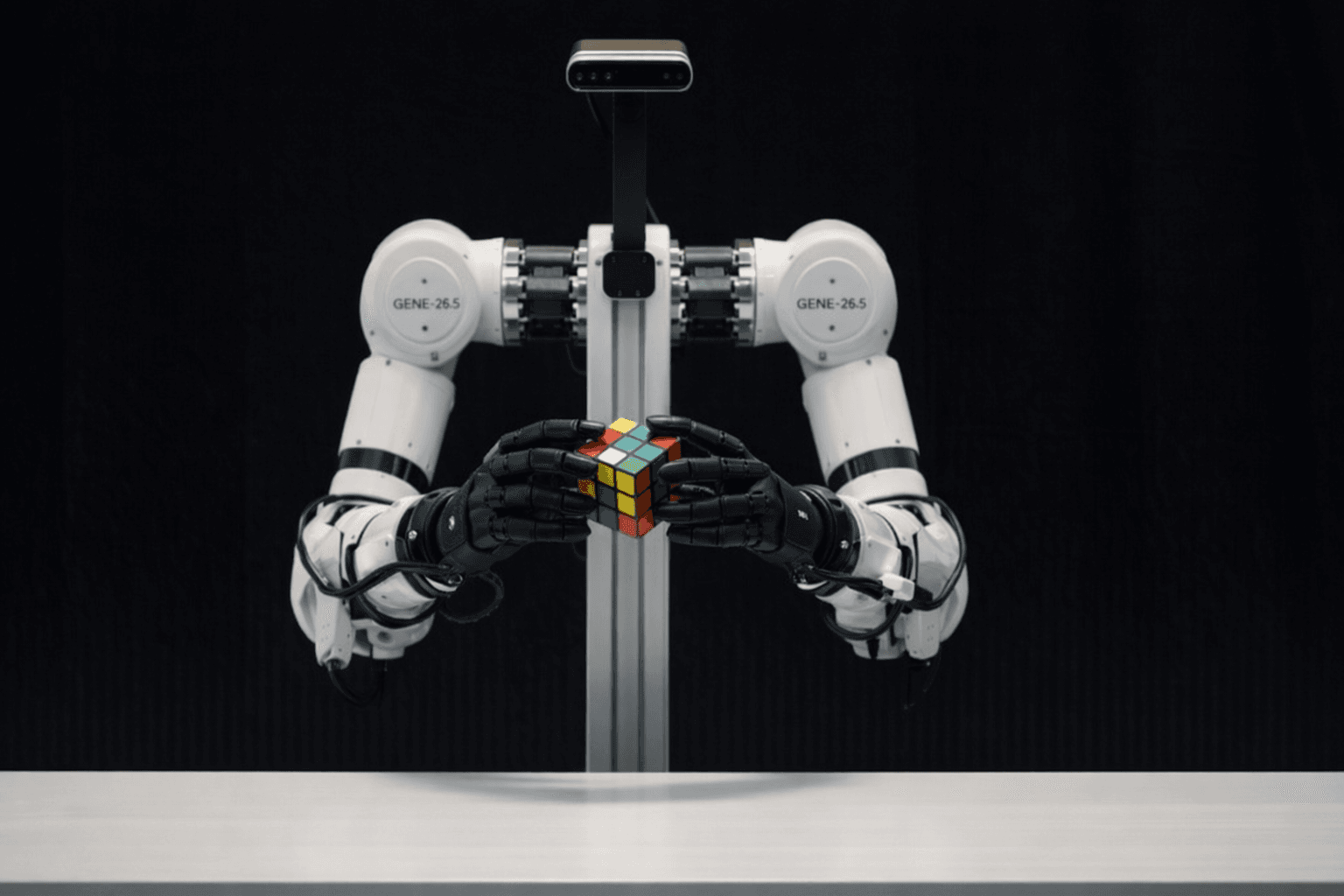
Maven is going after mixed palletizing — the warehouse task of building custom pallets of goods bound for individual retail stores. Derbas puts the addressable market at $80 billion. The robots sit on wheeled bases, move up to 10 miles per hour, and use two arms that lift up to 30 kilograms each, using vacuum suckers to arrange boxes pulled from incoming pallets.
“We saw how people were working; we zeroed in on flows we could immediately bring value to”— Hamza Derbas, Maven Robotics CEO and co-founder
The pitch is end-to-end automation rather than a single robot doing a single task. Maven's system hooks into a customer's warehouse management system on one side and loads mixed pallets onto outbound trucks on the other. Derbas frames the pace of retail as the underlying problem: within 48 hours of stocking shelves, retailers want to rebalance the product mix based on real-time demand, and today that rebalancing is done by humans running around a warehouse picking one of this and one of that.
Key facts
- 01Maven Robotics raised $100M from RoboStrategy, LocalGlobe, Vine Ventures, and XTX Markets Ventures to fund 250 third-generation robots.
- 02Eight Maven robots are running 16-hour shifts at customer sites with 99% or higher uptime after two years of partner work.
- 03The wheeled robots move at 10 mph and lift 30 kg per arm, targeting an $80B mixed-palletizing market.
- 04CEO Hamza Derbas spent nine years at Apple's special project group before starting Maven with his brother Khalid in 2024.
- 05Rival Agility Robotics is going public this fall via a $2.5B SPAC deal with a bipedal form factor Derbas calls unnecessarily complex.
The company's origin story is a sales-cycle steal. In 2024, when Maven had, in Derbas's words, a cartoon of a robot and a team of people, a consumer goods company was in town meeting four rival robot vendors. Derbas talked his way into a meeting, then asked to tour their factories and warehouses instead of pitching robots. Maven won the deal against companies with actual product shipping. Two years of joint work with that customer and a handful of others produced the current deployment.
The competitive frame Derbas draws is against Agility Robotics, which is going public this fall in a $2.5 billion SPAC deal and targets similar industrial workflows. Agility's robots are bipedal. Derbas, while stressing his respect for the company, argues the form factor is wrong for the job.
Derbas spent nine years at Apple's special project group — widely understood to have been the self-driving car effort that was disbanded in 2024 — before starting Maven that same year with his brother Khalid, a former private-equity investor who serves as CFO. That autonomous-vehicle lineage is common across physical AI startups, because self-driving teams built the most mature data pipelines for training hardware on real-world data. Maven runs a similar loop: pull data from operating robots within minutes or hours, retrain, evaluate, run ablation studies, redeploy.
Jack Pearson, an investor at RoboStrategy, said what distinguishes Maven is its industrial-systems background rather than a research culture optimized for learning benchmarks or a specific model architecture. That framing lines up with the company's stated strategy: pick one customer problem, ship, then pick the next. Derbas argues each sizeable problem is itself a multi-billion-dollar market with enough data to master the required skills.
The next push is harder. Palletizing is a constrained task with regular geometry. Moving into materials handling, then fabrication, will demand manipulation capabilities that don't yet exist in production robots. Maven plans to build on its own systems, license from third parties, and has already developed pincer-like gloves that let human workers demonstrate the gripper form factor the company wants to build toward.
The risk Derbas is running is model risk. If a frontier lab ships a general-purpose physical AI model that solves manipulation across arbitrary form factors, a task-by-task industrial specialist could be leapfrogged. Derbas's counter is that his customers do not care whose model wins — they care about ROI on labor spend, and generalized models still have to be productized against real warehouse workflows.
Maven's bet is that the money in robotics for the next several years sits with whoever can get 99%-uptime machines onto warehouse floors and connected to a WMS, not whoever posts the best benchmark. That is a defensible position while the frontier labs are still shipping demos. The $100M round buys Maven roughly two build cycles to turn eight deployed robots into hundreds and lock in the mixed-palletizing beachhead before a bigger player — model-first or hardware-first — decides the category is worth taking.

Working on something we should cover, or seeing a story we missed? Send leads, documents, or feedback to hello@aichatdaily.com. For sensitive tips, see our secure tips page for Signal and PGP options.
Spotted an error? Email hello@aichatdaily.com with the URL and the issue, or read our full corrections policy.