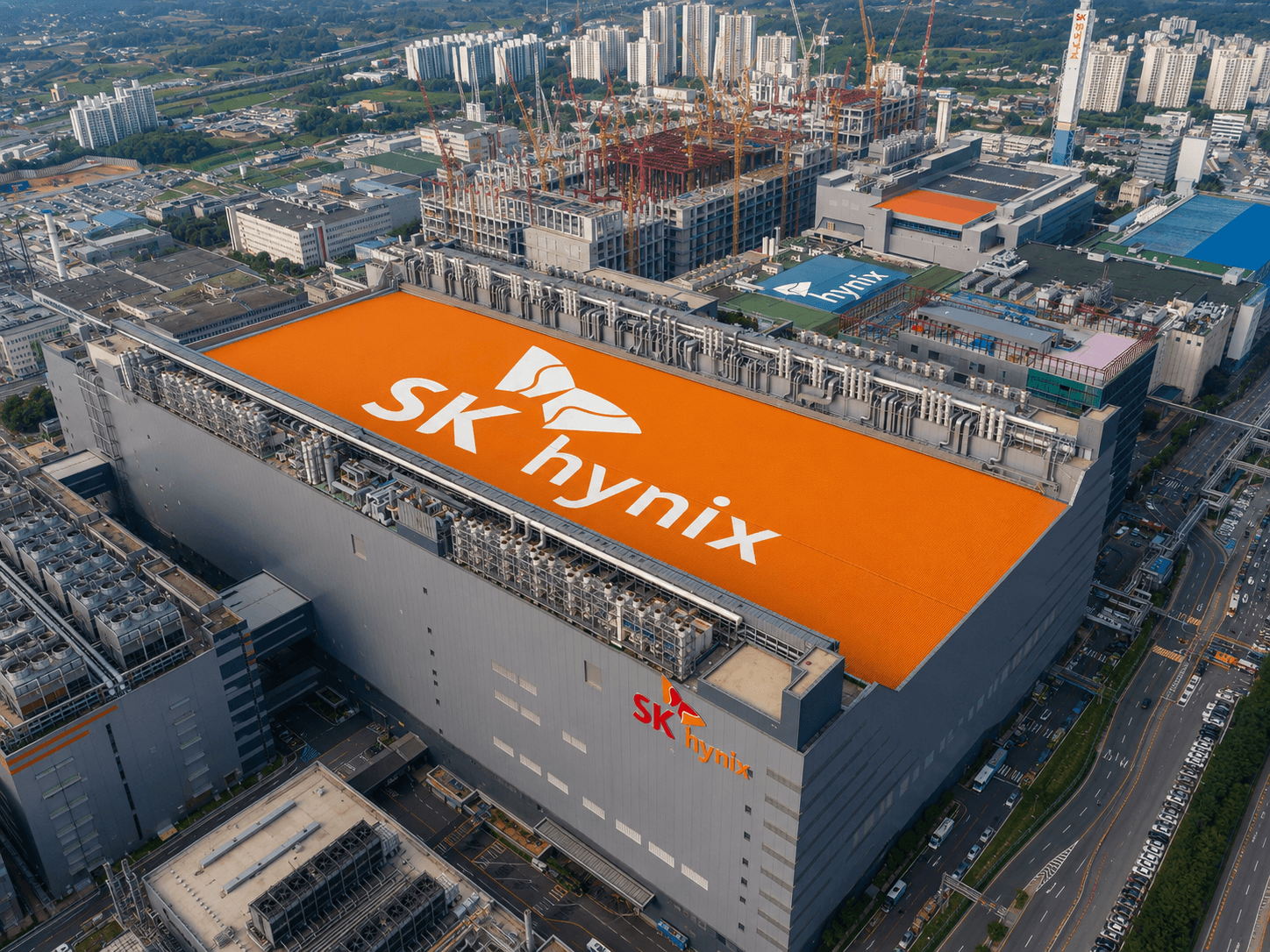
SK Hynix is paying its employees a $476,000 bonus this year, and Samsung engineers are quitting to chase it. The payout, funded by 10% of SK Hynix's operating profits under a deal struck last year, is a direct byproduct of the HBM chips the company sells to Nvidia for AI accelerators. Samsung's own foundry division, which makes logic chips for customers including Tesla and Google, is handing out roughly $135,000 per employee — less than a third of what its rival is paying — and the talent is voting with its feet.
In April, Samsung labor union chief Choi Seung-ho said more than 200 union members had left for SK Hynix over the previous four months. A June survey by the same union found 81.5% of employees in Samsung's foundry division wanted to move to another company within two years, along with nearly half of the semiconductor division as a whole. One Samsung engineer told MIT Technology Review that all 30 members of his team, minus two team leads, applied to an SK Hynix job posting in July.
“My team lead tells us all to jump ship to SK Hynix”— Lee, Samsung semiconductor division engineer
The gap traces back to how each company structures pay. SK Hynix pays out 10% of operating profits, mostly in cash. Samsung, after months of negotiations, agreed in May to pay 10.5% of its semiconductor division's operating profits as bonuses annually for 10 years — but each sub-division's bonus is tied to its own bottom line, and mostly in company stock that vests over three years. Samsung's memory division, also selling HBM, is paying roughly $400,000 per employee. The loss-making foundry gets the $135,000 figure.
Key facts
- 01SK Hynix is paying $476,000 per employee this year, funded by 10% of operating profits from HBM sales to Nvidia.
- 02Samsung's foundry division bonus came in at roughly $135,000, versus $400,000 in its memory division.
- 0381.5% of Samsung foundry employees told the labor union they want to leave within two years; more than 200 union members have already left for SK Hynix in four months.
- 04SK Hynix added 2,152 employees in the first half of 2026 and aims to double manufacturing capacity in five years.
- 05Samsung won an 18-month injunction in July barring two former chip workers from joining SK Hynix on national-technology grounds.
The reversal of fortune is recent. For decades, SK Hynix was the smaller memory maker that elite Korean engineering graduates skipped over for Samsung. In 2019, Samsung downsized its HBM team, betting the market would stay niche. SK Hynix doubled down. When the AI boom arrived, HBM prices surged, and SK Hynix now leads the global market. Both companies crossed $1 trillion in market value in May, and in June SK Hynix briefly overtook Samsung as South Korea's most valuable company.
Both are now spending to expand. Last month the two companies unveiled plans to invest more than $2 trillion by 2040, including a semiconductor mega-cluster in Yongin, south of Seoul. SK Hynix added 2,152 employees in the first half of 2026 alone and aims to double manufacturing capacity in five years. Samsung plans to hire 60,000 employees over the next five years. Even combined, the pipeline falls short: the Korea Semiconductor Industry Association projects the industry will need 304,000 workers by 2031 and faces a shortage of roughly 54,000.
That shortage is why the recruiting fight is being waged on bonuses rather than headcount alone. Baek, a manager at SK Hynix, told MIT Technology Review the company deliberately targets Samsung engineers when hiring.
“From what I heard internally, the big performance bonuses we got were aimed at luring away talent from our competitor.”— Baek, SK Hynix manager
In July, Samsung won an 18-month injunction barring two former chip workers from joining SK Hynix, arguing that chip technology qualifies as a national core technology deserving protection. The court sided with Samsung, writing that competitive fierceness in semiconductors makes it necessary to establish a fair market order. Whether that ruling slows the broader exodus, or just complicates individual moves, is unclear.
The talent bleed threatens a specific structural advantage. Samsung is the only memory maker in the world that also owns a foundry, and HBM4 — the next generation of the technology — requires the base logic chip in each memory stack to be manufactured with an advanced foundry process. Samsung can do this in-house. SK Hynix outsources the equivalent step to TSMC in Taiwan.
“If Samsung keeps losing engineers in the foundry … the collaboration between memory division and foundry division could become difficult”— Park Jun-young, semiconductor expert at the Industrial Anthropology Laboratory
If Samsung's foundry engineers keep leaving, that integration advantage weakens at exactly the moment HBM4 volumes ramp. And if SK Hynix, now hiring foundry engineers itself, closes the internal-collaboration gap, TSMC-dependence becomes less of a limitation. Choi, an engineer who has worked at Samsung for seven years, says he and his coworkers trade tips on new SK Hynix postings. He used to be a star on his team. Now, he says, there's no point putting in the extra work.
The AI compute stack has an obvious winner in Nvidia, but the memory that feeds those accelerators is a two-company race with real consequences for AI infrastructure pricing and supply. Samsung still has the balance-sheet and the integrated fab-plus-foundry footprint to compete on HBM4, but a workforce that is actively looking for the exit is a hard problem to solve with stock grants that vest in three years. If the bonus-driven poaching persists through the HBM4 ramp, the market share picture at the base of every AI training cluster could look meaningfully different by 2028.

Working on something we should cover, or seeing a story we missed? Send leads, documents, or feedback to hello@aichatdaily.com. For sensitive tips, see our secure tips page for Signal and PGP options.
Spotted an error? Email hello@aichatdaily.com with the URL and the issue, or read our full corrections policy.