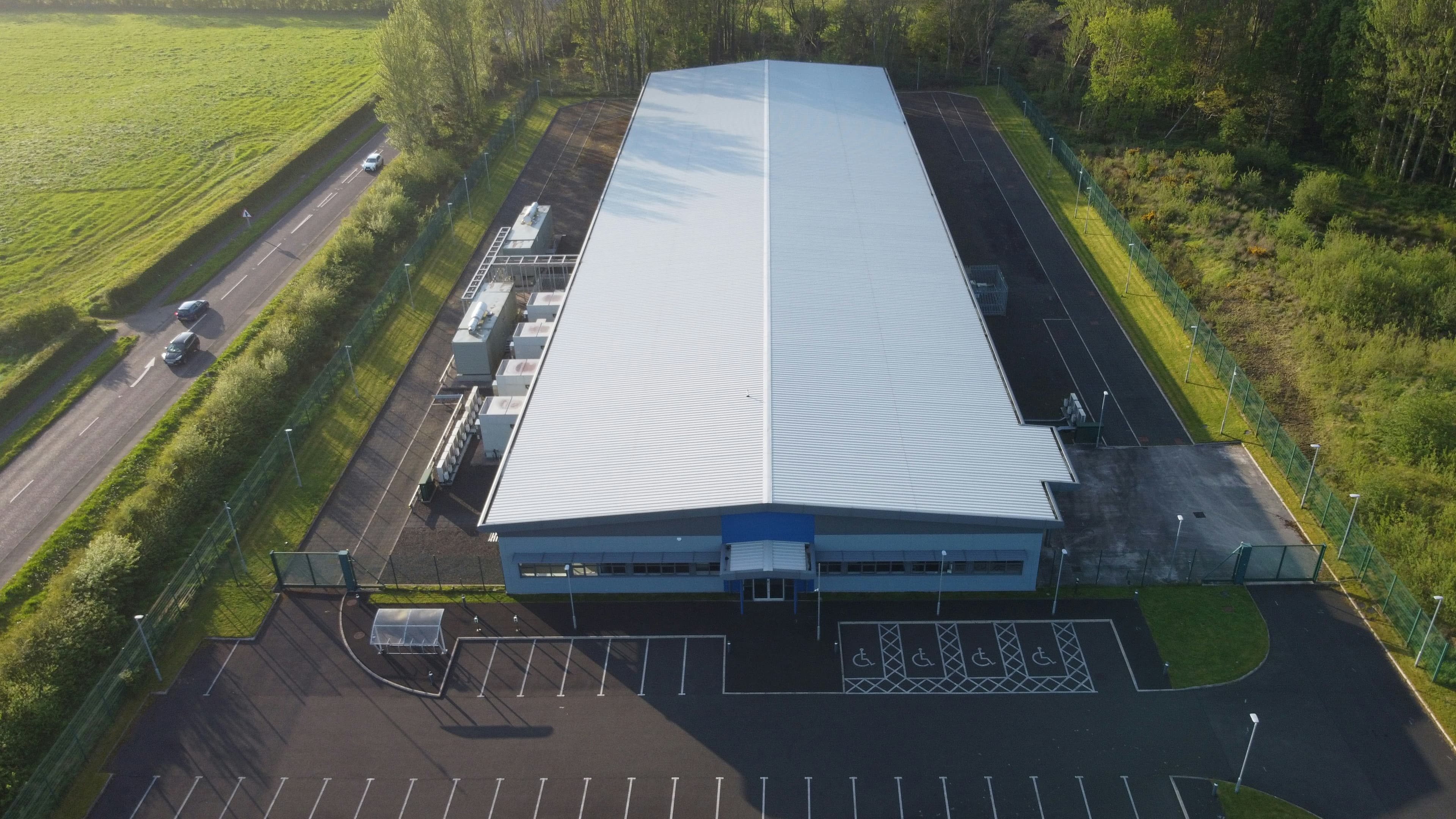
San Francisco startup SPAN wants to put AI data center hardware next to your house. The company announced a distributed compute scheme this week that would install thousands of XFRA nodes — each holding 16 liquid-cooled Nvidia RTX Pro 6000 Blackwell Server Edition GPUs — at single-family homes across the United States, with a 100-home pilot planned for 2026 and a buildout to 80,000 nodes by 2027 delivering over 1 gigawatt of distributed compute.
Hosts get something concrete in return. SPAN would cover the household's electricity and internet bills, offering either a flat utility fee — the company floated $150 — or potentially no fee at all, plus a 16 kilowatt-hour backup battery wired into the home through SPAN's smart panel and PowerUp software. The pitch is aimed initially at newly constructed homes, with SPAN owning and operating all the equipment.
The economic argument is aggressive. In a CNBC interview, SPAN claimed it could deploy 8,000 XFRA units for one-fifth the cost of building a conventional 100-megawatt data center with equivalent compute. By piggybacking on existing residential electrical service, the company sidesteps the land acquisition, water rights, substation upgrades, and multi-year permitting timelines that have turned hyperscale buildouts into political fights.
Key facts
- 01SPAN plans a 100-home XFRA pilot in 2026, scaling to 80,000 nodes and over 1 gigawatt of distributed compute by 2027.
- 02Each XFRA node packs 16 Nvidia RTX Pro 6000 Blackwell Server Edition GPUs, 4 AMD EPYC CPUs, and 3 terabytes of memory.
- 03Hosts get a flat utility fee — SPAN floated $150 — plus a free 16 kWh backup battery and subsidized internet.
- 04SPAN claims 8,000 XFRA units cost five times less than a 100-megawatt data center with the same compute.
- 05Each Nvidia GPU inside a node retails for roughly $10,000, raising theft and side-channel security concerns.
The technical premise rests on spare capacity in US homes. Standard 200-amp residential service — the norm for homes built in the last 30 years — leaves roughly 80 amps unused at any given moment. "Virtually all homes with 200-amp utility services have 80 amps available at all times, so we set that as the maximum power consumption for a single XFRA node," said Chris Lander, SPAN's vice president of XFRA. Each node also bundles four AMD EPYC server CPUs and three terabytes of memory alongside the 16 GPUs.
“SPAN claims it can install 8,000 XFRA units at one-fifth the cost of a typical 100-megawatt data center with equivalent compute capacity.”— Jaeden Schafer
SPAN designed the system to keep household appliances unaffected. Nodes "operate as always-on loads within verified residential capacity," Lander said, with the 16 kWh battery absorbing rare residential peaks. In extreme cases, PowerUp curtails flexible loads like EV charging based on homeowner-set priorities. During outages or utility demand-response events, the affected node's workload shifts elsewhere on the network and the battery powers the home — at no cost to the host.
The network isn't meant to compete with hyperscale training clusters from Google or Microsoft. SPAN is targeting AI inference, cloud gaming, and content streaming — workloads where latency to end users matters more than packing thousands of GPUs into one warehouse. Benjamin Lee, a computer architect at the University of Pennsylvania, told Ars Technica that "computation for AI inference can and should be distributed at the 'edge,' deployed on smaller platforms closer to population centers and users."
Lee added that distributed inference "could impose much smaller impacts on the grid because inference requires a few GPUs, unlike training which requires thousands of them working in concert." SPAN's pitch to utilities leans on this: rather than forcing costly transmission upgrades to serve gigawatt campuses, XFRA monetizes existing residential grid capacity. "Networks of XFRA nodes make electricity more affordable for the entire community because they increase sales over grid infrastructure that already exists," Lander said.
Not everyone is convinced the grid math works at the block level. Ari Peskoe, director of the Electricity Law Initiative at Harvard Law School, called the homeowner subsidy model "fascinating" but flagged a clustering risk. "If there's a block that has several homes with these devices, maxing out compute and energy would force a lot of power to that local area," Peskoe said. Lee also questioned whether downsizing to a few GPUs per site is necessary, suggesting conventional 20-megawatt data centers might deliver similar grid benefits versus 1-gigawatt hyperscale campuses.
Security cuts the other way too. Each node carries roughly $160,000 worth of Nvidia silicon — the RTX Pro 6000 Blackwell sells for around $10,000 apiece — sitting outside a private home rather than behind a fenced perimeter with badge readers. "Many side-channel attacks require physical proximity to the machine, which data centers can guard against," Lee said. "Distributed GPUs in individual homes are much more difficult to protect." Reddit threads about the pitch have already speculated about theft, and at least some commenters mused about helping themselves to the hardware.
SPAN's gambit lands in a stretch where Silicon Valley is openly debating orbital data centers and ocean-going compute barges as alternatives to siting more gigawatt campuses on land. Compared with launching servers to low Earth orbit — a path Google and SpaceX are reportedly exploring — bolting GPU nodes to suburban garages is comparatively pedestrian. It's also far easier to actually build in 2026.
The commercial question is whether SPAN can recruit homeowners, homebuilders, and utilities fast enough to matter. A 100-home pilot is small. Scaling to 80,000 nodes inside 18 months requires construction-partner deals, regulatory comfort from dozens of state utility commissions, and a security story that survives the first publicized theft. Each is solvable; none is automatic.
If even a fraction of the 1-gigawatt 2027 target ships, SPAN reframes the data center build-out as a distributed grid product rather than a real estate problem — a meaningful shift for inference economics and for any AI company tired of waiting on substation queues. If the pilot stalls on HOA fights, insurance disputes, or a single high-profile break-in, the idea becomes a footnote alongside every other distributed-compute experiment that didn't scale. The interesting variable is how quickly hyperscalers decide whether to compete with this model or quietly contract for capacity on it.

Working on something we should cover, or seeing a story we missed? Send leads, documents, or feedback to hello@aichatdaily.com. For sensitive tips, see our secure tips page for Signal and PGP options.
Spotted an error? Email hello@aichatdaily.com with the URL and the issue, or read our full corrections policy.