Theker, a Barcelona-based AI robotics startup, raised $85M in a Series A round led by CRV, with Samsung and Aglaé Ventures, the investment vehicle tied to LVMH chairman Bernard Arnault, joining the cap table. The company says the round is Europe's largest ever robotics Series A, and it closed less than a year after Theker's seed. Co-founder Carla Gómez Cano had been targeting $30M to $40M; the final number came in at roughly twice that.
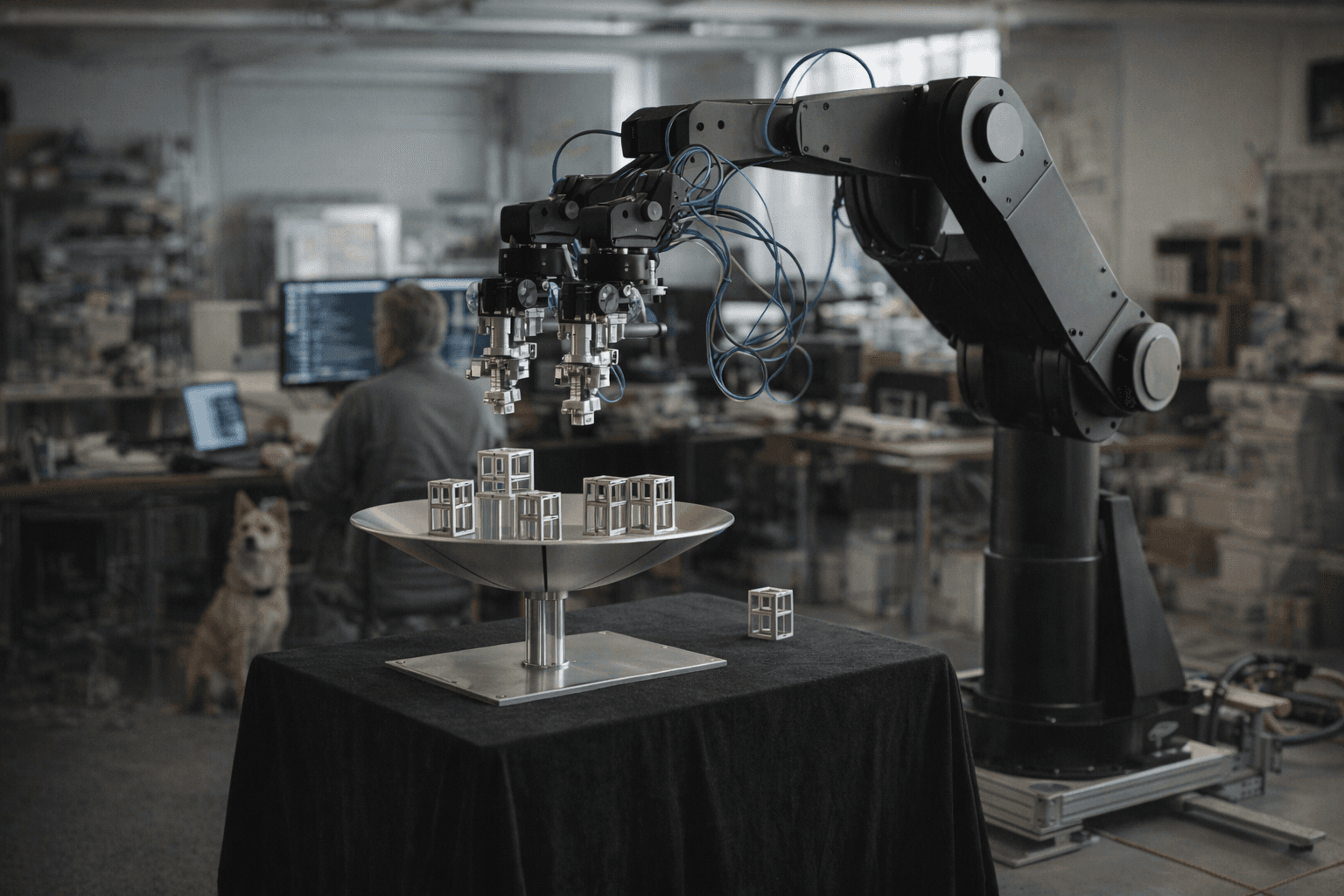
The pitch is a robot that doesn't specialize. Unlike fixed-form humanoids in the Boston Dynamics mold, Theker's machines are designed to be reconfigured — hands, arms, and overall form can be swapped or resized for the task, whether that's sorting packages, packing clothing, or handling bottles and cans in a warehouse. The argument is that most factory work doesn't look like a single repeated motion.
“If you always have to put the same cookie in the same box, that works perfectly, but most processes aren't like that.”— Carla Gómez Cano, Theker co-founder
Inditex, the parent of Zara, is an early backer, which anchors Theker in retail logistics for now. Gómez Cano said the longer goal is heavier industrial settings — manufacturing lines where the variation in manual tasks is wider and the throughput targets are higher. That positioning is what attracted CRV from the United States and pulled in Samsung and Arnault's family office in the same round.
Key facts
- 01Theker raised $85M in a Series A the company calls Europe's largest ever robotics Series A.
- 02CRV led the round, with Samsung and Aglaé Ventures, the investment vehicle of LVMH chairman Bernard Arnault, also participating.
- 03The round closed less than a year after Theker's seed and came in at roughly twice the $30M-$40M target co-founder Carla Gómez Cano initially set.
- 04Inditex, Zara's parent company, is an early backer; Samsung is in advanced discussions to become a customer.
- 05Theker has received 15,000 job applications and expects to grow from dozens of staff to as many as 120 by year-end.
Samsung is not yet a Theker customer, but Gómez Cano said the two are in advanced discussions. Theker would take Samsung as customer, supplier, and investor simultaneously — a combination that would give the startup a manufacturing reference at industrial scale, which is the credential most generalist-robotics startups lack. Gómez Cano also said the company skips corporate innovation departments and sells directly into logistics and operations, where budgets are real and deployment timelines are shorter.
To show it can deliver beyond demos, Theker runs a showroom in central Barcelona and plans to open additional sites as it expands across Europe, the U.S., and Asia. Hiring is the immediate constraint. The company is recruiting across engineering, deployment, and sales as it scales beyond pilot footprints into recurring commercial deals.
The applicant pool has been heavy. Gómez Cano estimated the team could grow from dozens of people today to as many as 120 by year-end, then caught herself on the projection: "I am saying that, but I also said that we'd raise $30 or $40 million!" The $85M outcome suggests the headcount number is, if anything, conservative.
“We already received 15,000 job applications and have to filter like crazy.”— Carla Gómez Cano, Theker co-founder
Theker is keeping headquarters in Barcelona, which Gómez Cano framed as a deliberate bet on Europe's tech ecosystem rather than a constraint. The city has become one of the region's emerging robotics hubs, and the company sees no friction in operating from there while selling into the U.S. and Asia. "It has never been a barrier to acceleration for us, so we are making the most of it," she said.
The competitive frame matters. Most well-funded humanoid-robotics startups — and most of the capital — have concentrated in the U.S. and Asia, around fixed-form bipedal designs aimed eventually at general-purpose labor. Theker is going in a different direction: modular hardware that adapts to a specific cell on a specific line, with software intended to handle the variation between tasks rather than the variation between environments. The $85M Series A is the largest European validation of that approach to date.
The risk is the same one every generalist-robotics company faces. A reconfigurable arm that handles many tasks acceptably can lose out, on any single task, to a fixed-purpose machine engineered for that one motion at lower cost. Theker's argument is that customers running mixed-SKU operations — apparel logistics, multi-product packaging, warehouse picking — value flexibility more than peak throughput on one task. That thesis will be tested as soon as Inditex deployments move from showroom demos to multi-site rollouts.
For European deep tech, this is the kind of round that resets expectations. An $85M Series A out of Barcelona, with CRV leading and Samsung and Arnault writing checks, signals that capital for industrial AI hardware is finally willing to underwrite European rounds at U.S. sizes when the customer pipeline is there. If Theker converts Samsung from prospect to customer, the next round will not be the question. The question will be how fast the company can build, ship, and service hardware in three regions at once.

Working on something we should cover, or seeing a story we missed? Send leads, documents, or feedback to hello@aichatdaily.com. For sensitive tips, see our secure tips page for Signal and PGP options.
Spotted an error? Email hello@aichatdaily.com with the URL and the issue, or read our full corrections policy.