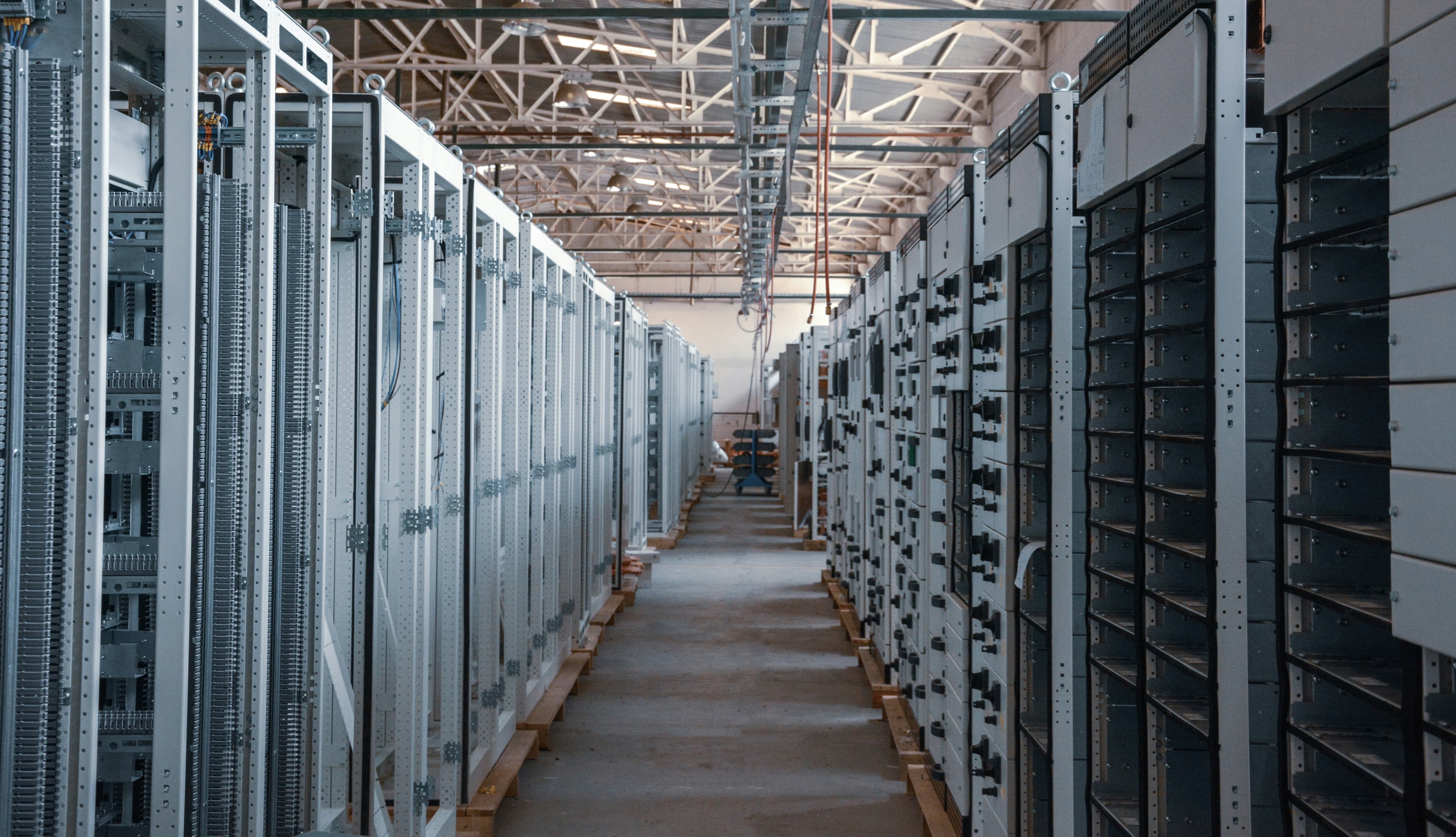
Meta is testing robots that plug in cables, power-cycle servers, and reseat hardware inside its data centers, using machines supplied by Watney Robotics, Kinova, and ABB. Current and former workers say one networking-cable bot could replace up to 80% of some technicians' workloads if the trial succeeds. The effort has run quietly across multiple sites, including the company's largest campus in Altoona, Iowa, which opened in 2014 and employs hundreds of workers.
In one experiment, Meta is evaluating a Kinova Gen3 robotic arm for power cycling — cutting electricity to servers on command. A separate robot is being tested for swapping networking cables, the task tied to the 80% figure. At other facilities, Meta has deployed a simpler device, a finger-like arm that presses the power button on a Mac Mini or similar hardware when a human triggers it remotely.
Eric Xu, senior manager for robotics at Meta, said at a conference last year that the company's long-term goal is to put robots inside data centers to speed incident response, monitor environments, and handle preventative maintenance. Meta declined to comment on the specific trials. Spokesperson Francis Brennan said the company is investing heavily in hiring and training, arguing the US faces a shortage, not a surplus, of skilled infrastructure workers.
Key facts
- 01Meta is testing robots from Watney Robotics, Kinova, and ABB to handle cable swaps, power cycling, and part reseats across its data centers.
- 02One worker estimates a networking-cable swap bot could replace up to 80% of some technicians' workloads if the trial succeeds.
- 03Watney's dual-armed robots have been running at Meta's Altoona, Iowa campus since June 2025; ABB scissor-lift robots are testing at the Prometheus site in New Albany, Ohio.
- 04Meta's Altoona campus opened in 2014, employs hundreds of workers, and receives tens of millions of dollars annually in property tax breaks.
- 05Meta this year launched a program to train thousands of workers annually in electrical, mechanical, and plumbing trades, with guaranteed jobs in Louisiana, Ohio, Indiana, and Texas.
The economics are shifting. Robot hardware has gotten cheaper, and the vision-language models steering them are far more capable than in earlier trials, when machines sometimes crushed servers attempting basic tasks. Since June, Meta has been running a pair of dual-armed Watney robots on cabling work at one Altoona building under human supervision. Watney launched in 2023 with a laundry-folding demo, then pivoted to data center work early last year, according to archived versions of its site.
At Prometheus, Meta's newest campus in New Albany, Ohio, four-wheeled ABB robots equipped with scissor-lift risers and six-axis arms are being used to reseat parts, with a roadmap toward more tasks and less human oversight. Meta's older 2023-era tugger robots, which move server racks, and its in-house barcode-reading inventory bot are already operating across sites in Iowa and Virginia. The inventory bot has limits: its camera is grayscale, so it cannot distinguish green from red indicator lights, and it struggles with corners and floor cables.
The pitch beyond cost is environmental flexibility. Paul Golding, who oversees physical intelligence at chipmaker Analog Devices, said customers increasingly want humanoid-run data centers because the buildings can then run hotter, darker, and cheaper. Microsoft and Google announced their own data center robotics investments last year, and Amazon has discussed robots for parts recycling. Ashley Llorens, a managing director at Microsoft's research accelerator, said pursuing robotics for tasks like replacing a faulty server rack is "absolutely something we're looking into at Microsoft."
“More and more of our customers are telling us 'we want to run our data centers using humanoid [robots]' because you can run them at higher temperatures, in the dark, and all these things.”— Paul Golding, Physical intelligence lead at Analog Devices
Workers see it differently. In Altoona group chats, the mood has turned, with staff writing that they expect to be gone in a few years because of the robots. Two workers said Meta is also building AI tooling that would let it hire lower-skilled, lower-paid technicians and centralize higher-level roles in cheaper metros like Denver. "They no longer want people who can think independently, come up with creative solutions, or perform complex troubleshooting," one worker said. "They want 'smart hands,' people who are just capable enough to follow AI instructions and not mess anything up."
The commercial case is not yet settled. Helen Oleynikova, CEO of Exclaim Robotics, which is building prototypes to replace broken parts and reset cables, said the sector is stuck at the pilot stage. Meta's own workers have complained about downtime while the machines recharge, and the inventory bot needs a human to open doors and move it between buildings by remote control. Meta previously explored drones as a faster alternative but did not pursue the idea.
The policy backdrop matters as much as the technology. Meta's Altoona campus still has several years left on a property tax break worth tens of millions of dollars annually, justified in part by local employment. Altoona Mayor Dean O'Connor said he had not thought much about robots displacing those jobs but framed automation as inevitable: "We will deal with it as it comes." Meta this year launched a program to train thousands of workers annually in electrical, mechanical, and plumbing trades at no cost, with guaranteed jobs in Louisiana, Ohio, Indiana, and Texas for graduates.
The Meta trials fit a pattern already visible on the software side — the same week Clara Shih left Meta after AI agents outperformed her top employees, the company was pushing hardware agents into its physical facilities. Data center labor is one of the last large, geographically distributed workforces in Big Tech that has resisted automation, largely because the fine-motor tasks were too fiddly for robots and too routine to justify keeping senior engineers on site. Meta's spend on AI infrastructure is what makes closing that gap urgent: every technician removed from a hyperscale campus compounds into meaningful margin at Prometheus-scale sites. Watney and Exclaim Robotics are betting the pilots turn into contracts before someone larger — ABB, or a humanoid vendor with a chip partner — corners the segment.

Working on something we should cover, or seeing a story we missed? Send leads, documents, or feedback to hello@aichatdaily.com. For sensitive tips, see our secure tips page for Signal and PGP options.
Spotted an error? Email hello@aichatdaily.com with the URL and the issue, or read our full corrections policy.