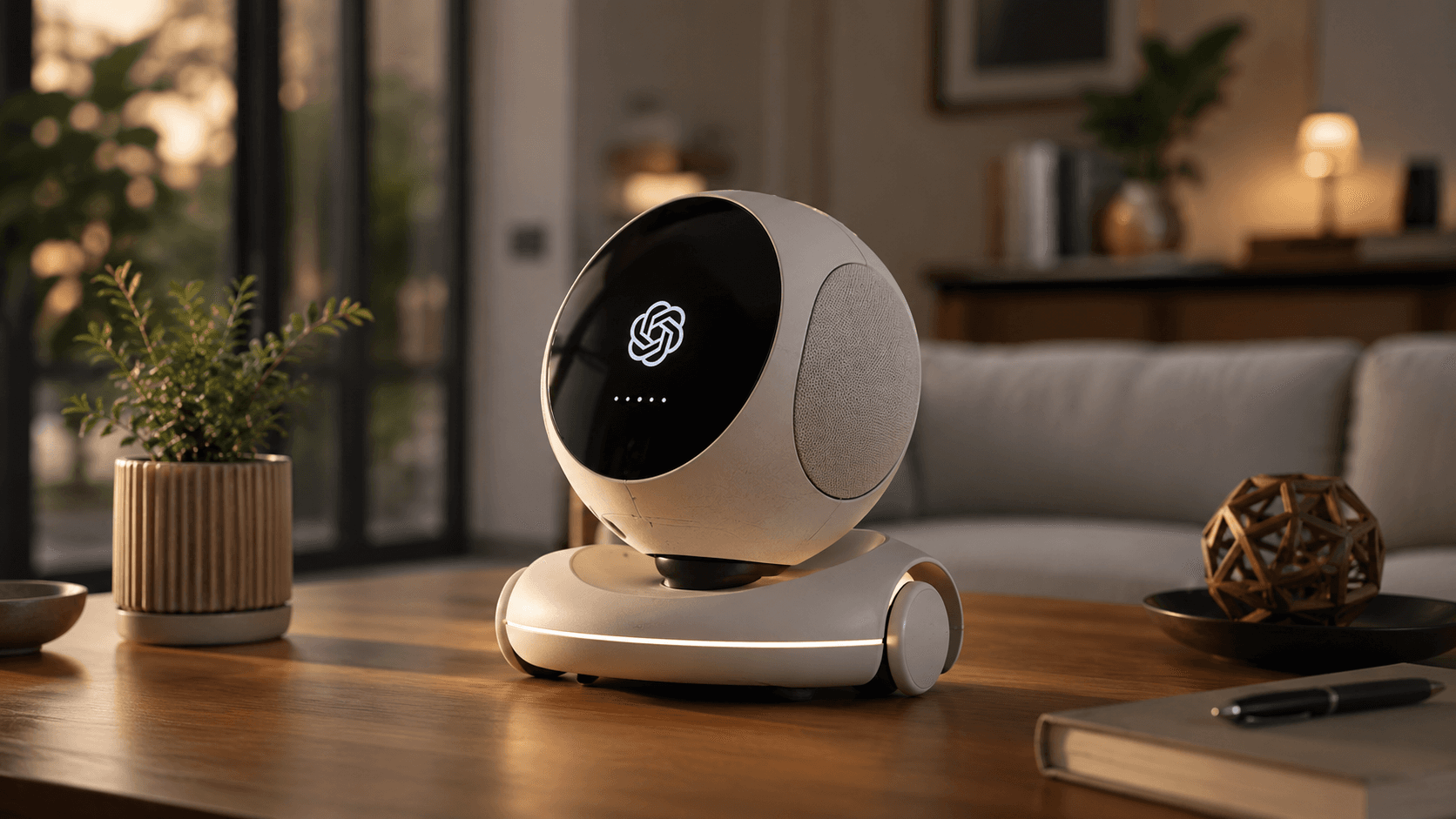
OpenAI's first hardware product is a screenless, mobile smart speaker designed to act as a live-in AI companion, according to a Bloomberg report Tuesday. The device syncs with ChatGPT, has no display, and is being pitched internally as a humanlike AI companion that lives in the home. It is still under development, with no ship date attached.
The most striking detail: the device includes mechanical elements that can move on their own. Bloomberg's sources describe it as engineered to feel like a companion and become a physical manifestation of ChatGPT, with a personality that learns about its owner over time and pulls context from emails and other parts of a user's digital life.
Development leaned heavily on former Apple engineers who worked on the iPhone and Mac, per Bloomberg. That talent pipeline is now the center of a legal fight: Apple sued OpenAI last week, accusing the company of stealing its trade secrets and calling the current allegations the tip of the iceberg, with more claims expected to surface in discovery. OpenAI has denied wrongdoing.
Key facts
- 01OpenAI's first hardware device is a screenless mobile smart speaker pitched internally as a humanlike AI companion for the home, Bloomberg reported Tuesday.
- 02The device includes mechanical elements that can move on their own and draws context from a user's emails and digital life.
- 03Development involved former Apple engineers who worked on the iPhone and Mac.
- 04Apple sued OpenAI last week over alleged trade-secret theft; OpenAI denies wrongdoing and says the product veers significantly from anything Apple sells.
- 05Rival Hark, founded by Brett Adcock, raised a $700M Series A in May at a $6B valuation to build 'personal intelligence' hardware.
OpenAI's response, relayed through Bloomberg's anonymous sources, is that the new product veers significantly from anything Apple has on the market today and that it is unlikely that it violates trade secrets. That framing matters. A mobile, moving, screenless speaker is a category Apple does not currently sell, which gives OpenAI room to argue the underlying design work is not derivative of iPhone or Mac IP.
The report follows earlier signals that OpenAI intends to ship consumer hardware. AI Chat Daily previously covered plans for a ChatGPT smart speaker targeted at 2027, developed with Jony Ive. Tuesday's Bloomberg description — screenless, mobile, mechanically animated — appears to be the sharpest picture yet of what that device actually is, rather than a separate product line.
The strategic logic is that a phone-shaped OpenAI device would land directly in Apple's kill zone, both legally and competitively. A moving, screenless companion sidesteps the iPhone form factor entirely and instead competes with Amazon Echo and Google Nest — categories where the incumbents have under-invested in generative AI. It also positions ChatGPT as an ambient presence rather than an app users have to open.
OpenAI is not alone in chasing AI-native hardware. Hark, the AI lab founded by Brett Adcock, raised an oversubscribed $700 million Series A in May at a $6 billion valuation to build what it calls personal intelligence — proprietary AI models paired with custom hardware designed as a universal interface between humans and machines. Hark has not disclosed its device's form factor, which underscores how much capital is being committed to this category before any product ships.
The unknowns are substantial. Bloomberg's report does not include a price, a launch window, a production partner, or a manufacturing location. It does not describe battery life, connectivity, or what mechanical elements that can move on their own actually means in practice — whether the device rotates toward a speaker, follows a user around a room, or something else. OpenAI has not publicly confirmed the product exists.
The Apple lawsuit is the more immediate risk. Even if OpenAI's design is legally clean, discovery in a trade-secrets case will pull in the former Apple engineers who now work on this device, their prior work histories, and internal design documents. That process alone can slow a hardware roadmap by quarters, especially for a first-generation product where the engineering team is still small.
For OpenAI, hardware is the logical next expansion after the model, the app, and the API. Owning a physical endpoint means owning the wake word, the microphone, the always-on context, and eventually the payments flow — the same stack Apple, Amazon, and Google have used to defend their ecosystems for a decade. A screenless companion that moves is an unusual first pick, but it is also the kind of bet that only makes sense if the goal is to define a new category rather than take share in an existing one. Whether the device ships in a form users actually want is the question that will determine whether OpenAI becomes a platform company or remains, for now, a model provider with a very good app.

Working on something we should cover, or seeing a story we missed? Send leads, documents, or feedback to hello@aichatdaily.com. For sensitive tips, see our secure tips page for Signal and PGP options.
Spotted an error? Email hello@aichatdaily.com with the URL and the issue, or read our full corrections policy.