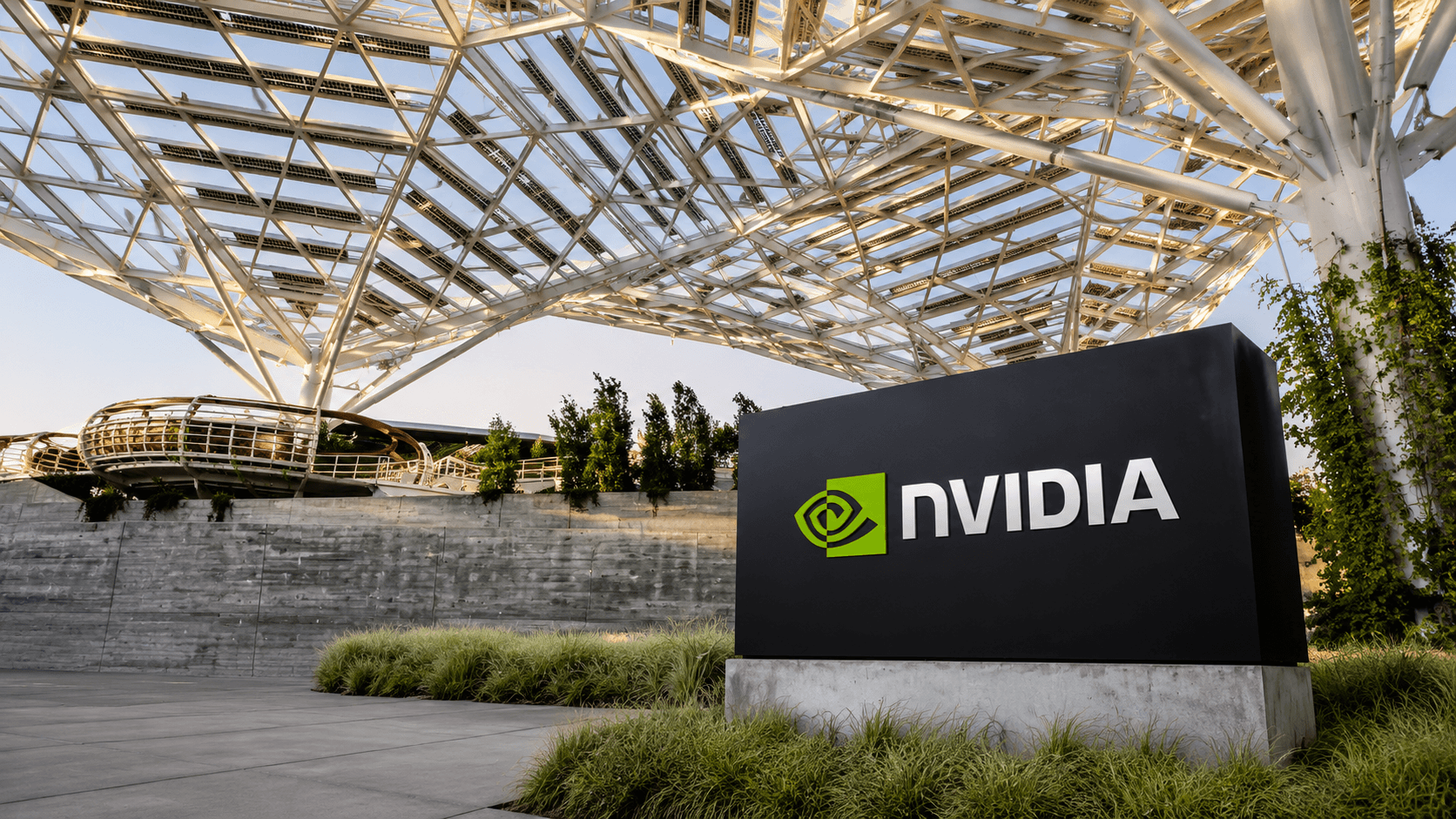
Nvidia is selling $25 billion of investment-grade debt in the US on Monday, its first bond sale in five years and a direct test of how much more AI-sector exposure bond investors will absorb. The seven-part offering spans maturities from two years to 30 years and was upsized from an initial $20 billion target after orders crossed $85 billion by early afternoon in New York, according to people familiar with the deal.
Demand was strong enough to tighten pricing meaningfully. The 10-year tranche is expected to yield 0.5 percentage points above US Treasuries, down from 0.75 points during initial discussions. Goldman Sachs, JPMorgan, and Morgan Stanley are active bookrunners.
The raise is at least five times the size of Nvidia's previous bond sale in 2021, when the company brought in roughly $5 billion during the coronavirus pandemic. When the new deal closes, Nvidia's debt outstanding will more than triple to about $30 billion from $8.5 billion today. Nvidia said proceeds will go to "general corporate purposes, including repayment and refinancing of outstanding notes."
Key facts
- 01Nvidia priced a seven-part bond offering at $25B on Monday, upsized from an initial $20B target after orders topped $85B.
- 02The 10-year tranche came in at 0.5 percentage points over US Treasuries, tightening from 0.75 points during initial discussions.
- 03The deal more than triples Nvidia's debt outstanding to about $30B from $8.5B, and is at least five times its $5B 2021 raise.
- 04Nvidia's free cash flow rose 59% to $96.6B in the year to January, even as its market cap slipped below $5T from a $5.7T May peak.
- 05Nvidia has committed over $90B to AI developers and suppliers including OpenAI, Anthropic, xAI, CoreWeave, and Nscale.
Favorable conditions after the US-Iran deal are letting Nvidia borrow cheaply, said Lauren Wagandt, a portfolio manager at T Rowe Price. Nvidia carries a double-A credit rating, the third-highest score available, and rarely taps the bond market — a scarcity premium that helps explain the order book. By comparison, the more indebted AI infrastructure player Oracle sits just two notches above a junk rating.
The timing matters. Tech groups are racing to lock in funding amid an intensifying AI buildout, even as Wall Street absorbs a torrent of competing new issuance — including SpaceX's record $75 billion initial public offering. Early signs of market fatigue have pushed some companies toward alternative structures: Anthropic recently sealed a $35 billion private credit deal backed by Broadcom, and Google parent Alphabet issued equity for the first time in more than two decades earlier this month, raising $85 billion.
Nvidia itself is the central beneficiary of that spending. Free cash flow in the year to January jumped 59% to $96.6 billion, driven by sales of the chips that train large language models including OpenAI's GPT family and Claude from Anthropic. Even so, Nvidia's market capitalization slipped below $5 trillion at the end of last week, down from a roughly $5.7 trillion peak in May as the broader semiconductor complex pulled back.
What gives bond investors pause is what Nvidia is doing with all that cash. The company has committed more than $90 billion to AI customers and suppliers, including equity stakes in OpenAI, Anthropic, and xAI, plus component makers Coherent, Marvell, Lumentum, and Corning. It has also agreed to act as a backstop or financial guarantor for cloud providers building on its chips, including CoreWeave and Nscale.
“The market has started to get worried about these circular financings, because if somebody in that ecosystem is having a problem, then the whole thing could be a problem.”— Tom Murphy, Global head of investment-grade credit at Columbia Threadneedle Investments
That web of cross-investments and guarantees is the real risk underlying Monday's deal. Tom Murphy, global head of investment-grade credit at Columbia Threadneedle Investments, said bond investors have grown wary of how tightly the AI ecosystem is now wound around a few balance sheets. If a single major customer of Nvidia's chips runs into trouble servicing its own AI buildout, the loss cascades back through guarantees, equity stakes, and forward purchase commitments — and Nvidia is on multiple sides of those trades.
For now, the order book settles the question of appetite. A nearly four-times-covered book at a tightened spread tells you that AAA-adjacent AI exposure still clears at attractive pricing, even after a multi-week semiconductor selloff. The harder question is what happens when the next AI infrastructure name — one without Nvidia's cash flow or credit rating — tries the same trade. Oracle's spread already prices in real concern, and the private credit pivot from Anthropic suggests issuers further out the risk curve are quietly routing around public markets. Nvidia just demonstrated the ceiling of what AI debt demand looks like; the floor is what everyone else will be watching.

Working on something we should cover, or seeing a story we missed? Send leads, documents, or feedback to hello@aichatdaily.com. For sensitive tips, see our secure tips page for Signal and PGP options.
Spotted an error? Email hello@aichatdaily.com with the URL and the issue, or read our full corrections policy.