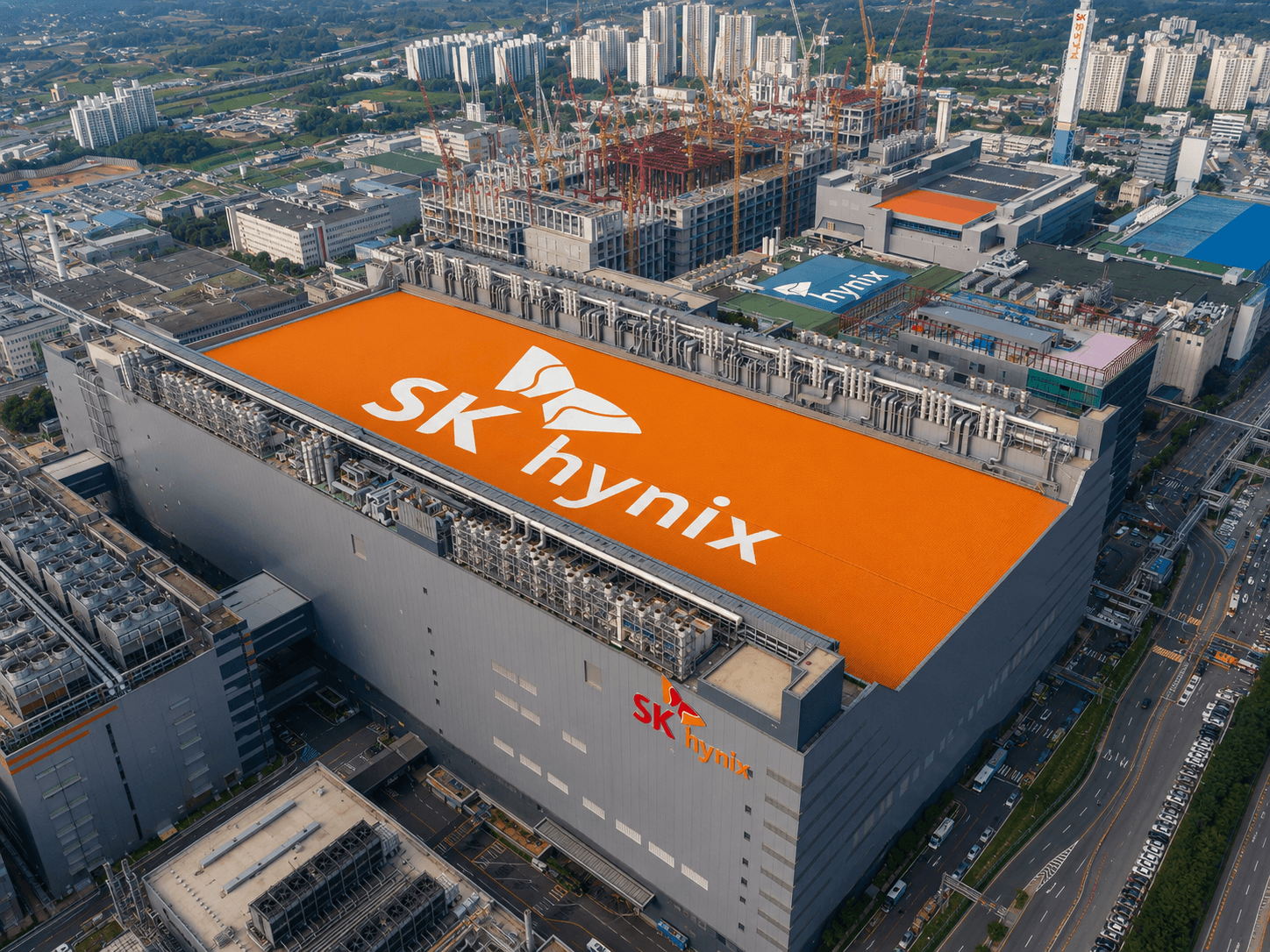
SK Hynix is approaching a $1 trillion market value, a threshold reached by only a handful of companies and one that would put a memory maker alongside the chip designers it supplies. The Korean firm has become the central beneficiary of the AI buildout on the memory side, much as NVIDIA has on the accelerator side. Its rise reframes what investors are willing to pay for the picks-and-shovels layer of the AI economy.
The catalyst is high-bandwidth memory, or HBM — the stacked DRAM that sits next to AI accelerators and feeds them data fast enough to keep their tensor cores busy. SK Hynix is the leading supplier of HBM to NVIDIA, whose Hopper and Blackwell GPUs anchor most of the world's frontier AI training clusters. Every additional GPU shipped is, in effect, additional HBM revenue for SK Hynix.
A $1 trillion valuation would mark a category shift for the memory industry. Memory has historically been a cyclical commodity business priced like a utility, with DRAM and NAND prices oscillating between feast and famine. The AI cycle has changed the demand profile: HBM is supply-constrained, sold under long-term contracts, and priced at a premium to commodity DRAM.
Key facts
- 01SK Hynix is closing in on a $1 trillion market value, driven by AI memory demand.
- 02The company is the leading supplier of high-bandwidth memory used in NVIDIA's AI accelerators.
- 03A $1 trillion valuation would place SK Hynix in a tier occupied by only a handful of global companies.
SK Hynix's lead in HBM rests on a head start in process technology and yield. The company began shipping HBM3 in volume before competitors and has stayed ahead on HBM3E, the version pulled into NVIDIA's current-generation accelerators. Samsung and Micron are both pushing to close the gap, but customers planning AI deployments through 2026 have largely locked in supply from SK Hynix.
“SK Hynix is approaching a $1 trillion market value, a threshold reached by only a handful of companies and one that would put a memory maker alongside the chip designers it supplies.”— Jaeden Schafer
The strategic question is how long that lead holds. HBM is one of the most demanding packaging problems in semiconductors, stacking DRAM dies vertically with through-silicon vias and pairing them with a logic base die. Yields have been the choke point industry-wide, and qualifications with NVIDIA are slow and expensive. Both factors favor the incumbent, at least for the next product generation.
The customer-concentration risk is real. A meaningful share of SK Hynix's HBM revenue flows through NVIDIA, whose own customer base is itself concentrated in a small number of hyperscalers — Microsoft, Amazon, Google, Meta, and Oracle. Any pause in AI capex from those buyers would ripple straight back through NVIDIA's order book and into HBM volumes.
There is also a competitive overhang. Samsung is the larger memory company by total revenue and has the balance sheet and fab capacity to spend its way back into HBM leadership if it solves its yield issues. Micron, the US-based third player, is expanding HBM3E production and benefits from supply-chain diversification pressure on customers wary of single-source dependence on a Korean supplier.
Geopolitics adds a second variable. Korea sits between US export-control regimes and Chinese demand, and HBM has been pulled into the same export-control conversation as advanced GPUs. SK Hynix has so far navigated the restrictions without major revenue impact, but the rules are tightening and the company's China exposure is non-trivial.
What the $1 trillion threshold signals, if it holds, is that the market is now pricing memory makers — at least the ones with HBM exposure — as AI infrastructure plays rather than commodity cyclicals. That is a structural rerating, not a cyclical one, and it depends on AI training and inference demand continuing to grow faster than HBM supply can be added. The risk is that the cycle eventually turns, supply catches up, and the multiple compresses back toward historical memory-industry norms.
For the broader AI supply chain, SK Hynix's run is a reminder that the value created by the AI boom is not flowing only to model labs and GPU designers. The companies one layer down — memory, advanced packaging, optical interconnect, power delivery — are capturing real margin, and the market is starting to price them accordingly. Whether SK Hynix crosses the $1 trillion line this quarter or next, the rerating of the memory layer is already done.

Working on something we should cover, or seeing a story we missed? Send leads, documents, or feedback to hello@aichatdaily.com. For sensitive tips, see our secure tips page for Signal and PGP options.
Spotted an error? Email hello@aichatdaily.com with the URL and the issue, or read our full corrections policy.