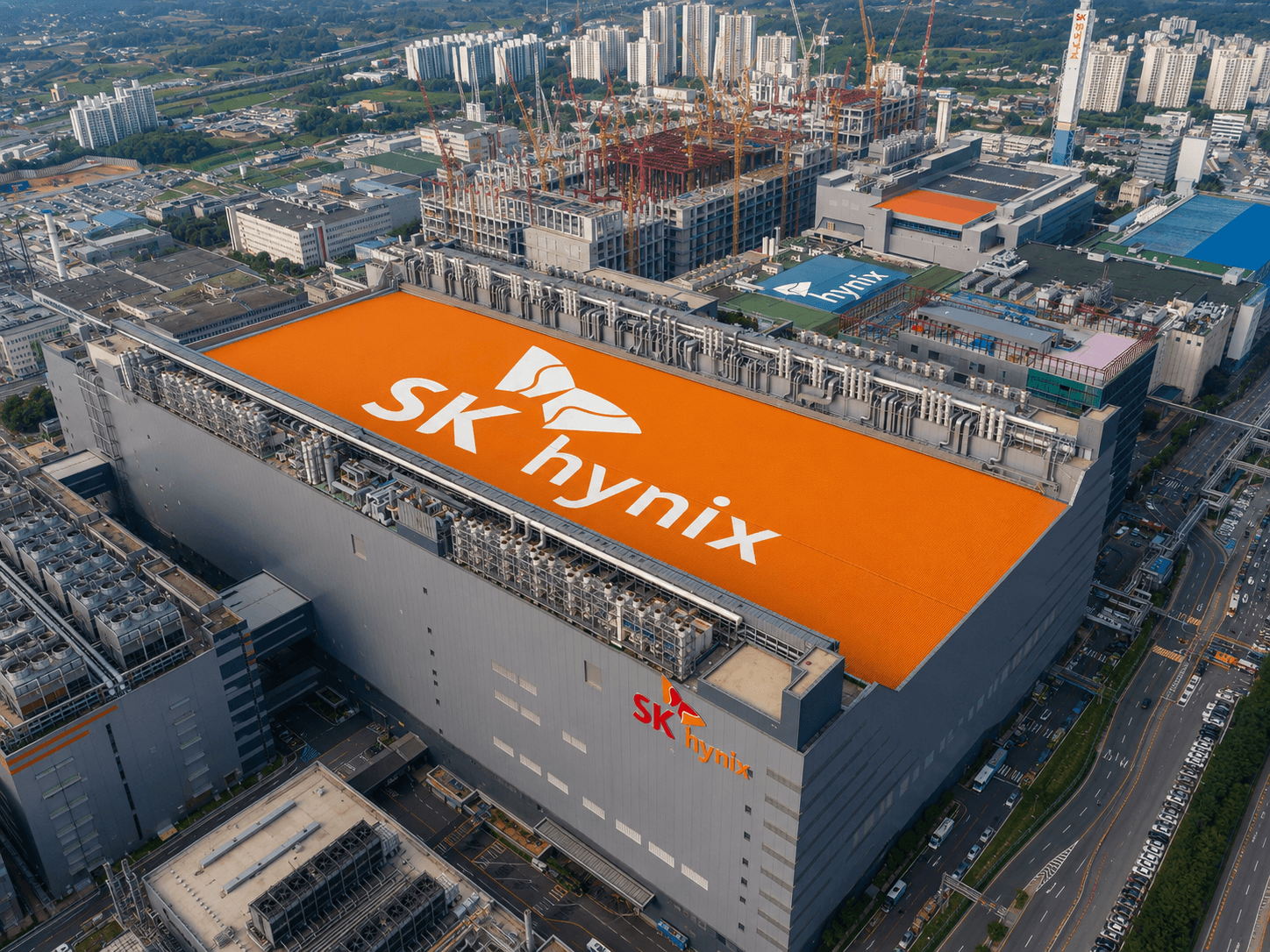
SK Hynix is in talks with Intel about a deal that would see the South Korean memory maker produce chips inside US fabs for the first time, according to Reuters. The arrangement, if signed, would put the world's leading supplier of high-bandwidth memory onto American soil at exactly the moment HBM has become the tightest constraint in the AI accelerator supply chain. Neither company has confirmed the discussions publicly.
SK Hynix currently manufactures the bulk of its memory in South Korea, with additional capacity in China. A US production footprint would be a structural change to how HBM — the stacked DRAM that sits next to every Nvidia and AMD AI GPU — reaches American data centers. Every H100, H200, B200, and MI300X shipped into a US hyperscaler today contains memory that crossed the Pacific to get there.
For Intel, the talks arrive as the company's foundry business hunts for anchor customers. Intel Foundry's pitch has been that its US fabs can serve customers who want manufacturing outside Taiwan and Korea, but signing marquee logic customers has been slow. A memory partnership with SK Hynix would be a different kind of win — not a logic node contract, but a co-tenancy arrangement that puts a proven memory maker inside Intel facilities.
Key facts
- 01SK Hynix is in talks with Intel to manufacture memory chips inside US fabrication facilities, according to Reuters.
- 02The arrangement would mark the first time SK Hynix produces memory on American soil.
- 03SK Hynix is the dominant supplier of high-bandwidth memory to Nvidia's AI accelerators.
- 04Intel Foundry has been searching for anchor customers to justify its US manufacturing buildout.
The details Reuters reports are thin: the two sides are talking, the destination is US soil, and the product is memory. What's unresolved is the structure. It could be a straight foundry deal where Intel manufactures to SK Hynix designs, a joint venture, a facility lease, or a hybrid where SK Hynix operates its own line inside an Intel campus. Each structure carries different implications for who owns the process technology and who books the revenue.
The AI angle is the reason this story matters beyond semiconductor trade press. HBM supply has been the binding constraint on AI accelerator shipments for more than a year. SK Hynix, Samsung, and Micron are the only three suppliers, and SK Hynix has led on both volume and yield for the HBM3 and HBM3E generations that Nvidia's top parts require. Nvidia's roadmap through 2027 assumes HBM supply keeps scaling; any move that adds US-based capacity feeds directly into that roadmap.
US industrial policy is the other backdrop. The CHIPS Act was designed to pull exactly this kind of manufacturing onshore, and memory has been a persistent gap in the American semiconductor footprint. Micron has committed to new US fabs, but adding SK Hynix as a second onshore HBM producer would change the concentration risk that has kept AI hardware buyers nervous.
Intel's position in the talks is more complicated than SK Hynix's. Intel is simultaneously a potential manufacturing partner, a competitor in AI accelerators through its Gaudi line, and a company whose foundry strategy has been under sustained investor scrutiny. A deal that brings a Korean partner into US Intel facilities is easier to defend to Washington than to Wall Street, where the immediate question will be what Intel gives up on utilization and margin to land the contract.
There are reasons the talks may not close. SK Hynix has spent years optimizing its Korean and Chinese fabs for HBM stacking, and moving even a portion of that process to a partner facility introduces yield risk on a product line where yield determines who wins the Nvidia socket. Trade policy could also shift the calculus in either direction depending on tariff and export-control changes over the next several quarters.
If the deal lands, the winner outside the two companies is the AI accelerator supply chain. Onshore HBM capacity shortens lead times for US data center operators, reduces exposure to a single-region disruption, and gives Nvidia, AMD, and every hyperscaler designing custom silicon a second geography to draw from. The AI hardware bottleneck of the past 24 months has been memory, not logic, and adding a US source for the tightest piece of the stack is a structural fix rather than a cyclical one — which is why a set of talks that would ordinarily be a niche foundry story is worth watching closely.

Working on something we should cover, or seeing a story we missed? Send leads, documents, or feedback to hello@aichatdaily.com. For sensitive tips, see our secure tips page for Signal and PGP options.
Spotted an error? Email hello@aichatdaily.com with the URL and the issue, or read our full corrections policy.