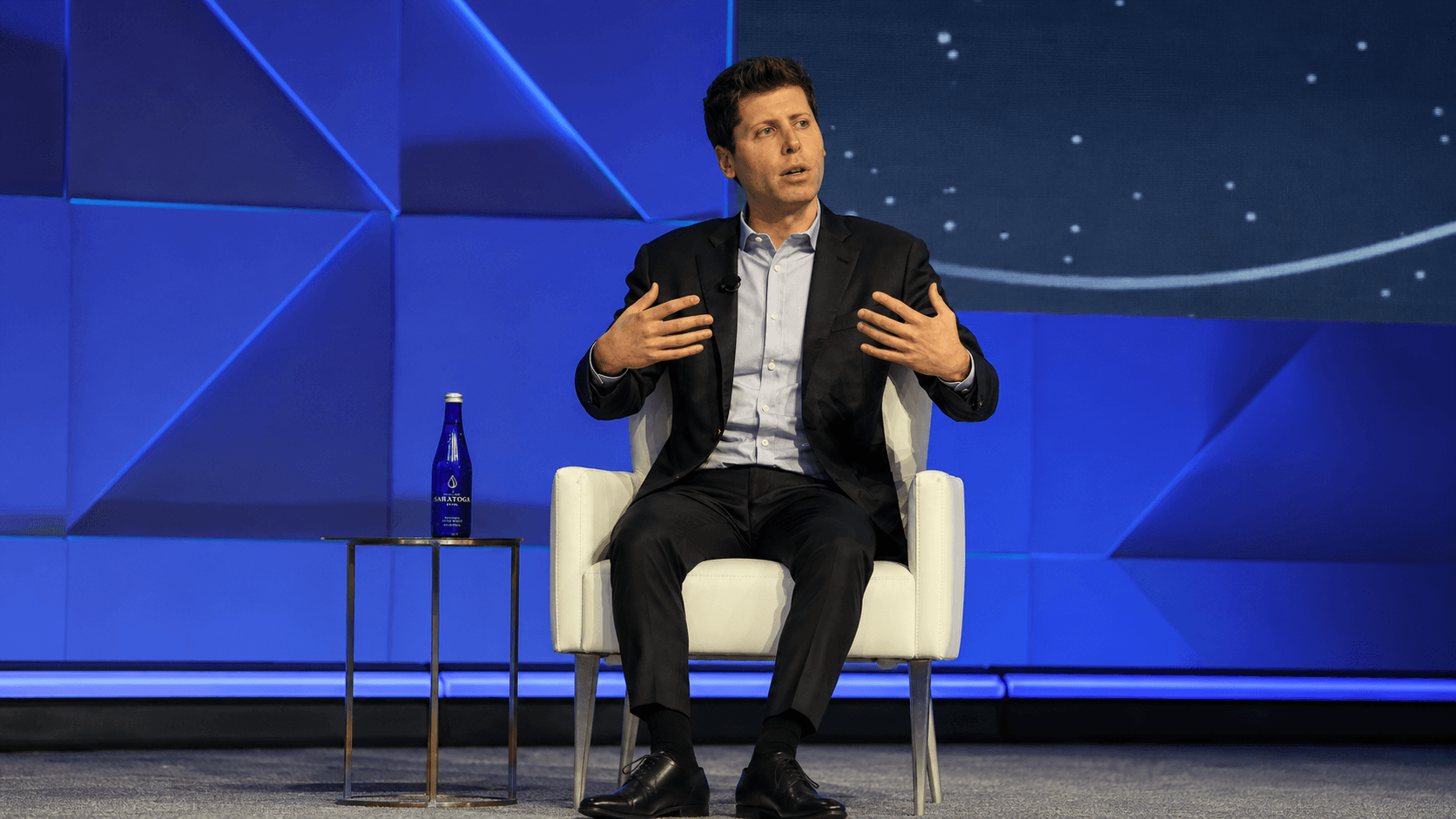
OpenAI CEO Sam Altman said on Monday that humans must remain in control of AI's future, calling it a principle with "no room for debate." Speaking at the opening ceremony of ADIPEC, the Abu Dhabi International Petroleum Exhibition and Conference, Altman said AI should be "a tool built for people" and that the commitment sets OpenAI apart from other AI companies.
Altman, who was in conversation with The National's editor-in-chief Mina Al-Oraibi, said OpenAI intends to "fight for" that position. He said human judgment, creativity and accountability have to stay central as models grow more capable, and that the industry must show it can prevent serious safety and alignment incidents as those systems advance.
“We think it is absolutely critical that people remain in control of the future”— Sam Altman, CEO of OpenAI
The control message came alongside a blunt read on how far capabilities moved in 2026. Altman said AI was mostly not as smart as the world's best scientists at the start of the year and is now mostly smarter than them. He added that AI can already do "a lot of parts" of many white-collar jobs.
Key facts
- 01Sam Altman told ADIPEC in Abu Dhabi on November 2 that there is "no room for debate" that humans must stay in control of AI.
- 02Altman said AI went from trailing the smartest scientists at the start of 2026 to mostly outperforming them.
- 03He estimated AI queries are 1,000 to 100,000 times more energy-efficient than a few years ago, yet named energy as his biggest challenge.
- 04Altman said the top AI user now consumes about 500 billion tokens a month; the global per-capita average is about 100,000.
- 05He said about 80% of young people in the UAE use ChatGPT.
He put numbers on the growth in usage. Six years ago, OpenAI's heaviest internal user consumed about 100,000 tokens a month. Altman said that figure is now roughly the global per-capita average, while the top user consumes about 500 billion tokens a month.
“At the start of this year, AI was mostly not as smart as our smartest scientist, and now it's mostly smarter than them.”— Sam Altman, CEO of OpenAI
Asked in a quick-fire round to name his biggest challenge, Altman answered with one word: "Energy." He said the energy cost of a single AI query has fallen sharply, estimating that queries are "thousands or hundreds of thousands of times maybe more efficient" than they were three to four years ago. Efficiency has not cut total demand. "As we make it more efficient, we just want to use it much more," Altman said.
Altman described physical power supply as AI's main bottleneck. "Atoms are still atoms," he said, pointing to the generation, equipment and infrastructure needed to run data centers. He called energy a dominant factor in the cost and availability of AI, said the AI and energy sectors share a duty to meet the demand, and said he hopes AI eventually produces a net increase in global energy availability, including by helping companies design new turbines.
“I think we are all not dreaming big enough because we're all kind of used to last year's models”— Sam Altman, CEO of OpenAI
Altman also told The National that OpenAI had solved one of the Millennium Prize problems, using about 10,000 agents running an upcoming GPT model for roughly four days. The National noted the claim could not be immediately verified independently.
The claim refers to OpenAI's September account of a result on the Navier-Stokes problem. The Clay Mathematics Institute, which administers the prizes, said the problem had "apparently been settled" and that evaluation would take time. OpenAI has said it does not intend to claim the prize.
On the host country, Altman called the UAE "consistently the most forward-looking country in the world for AI adoption" and said about 80% of young people there use ChatGPT.
The appearance followed four agreements between OpenAI and Abu Dhabi spanning government services, energy, education and investment. Under one, ADNOC will work with OpenAI and G42 to deploy OpenAI Frontier across field development, well management and commercial operations, making it the first energy company to use the platform.

Working on something we should cover, or seeing a story we missed? Send leads, documents, or feedback to hello@aichatdaily.com. For sensitive tips, see our secure tips page for Signal and PGP options.
Spotted an error? Email hello@aichatdaily.com with the URL and the issue, or read our full corrections policy.