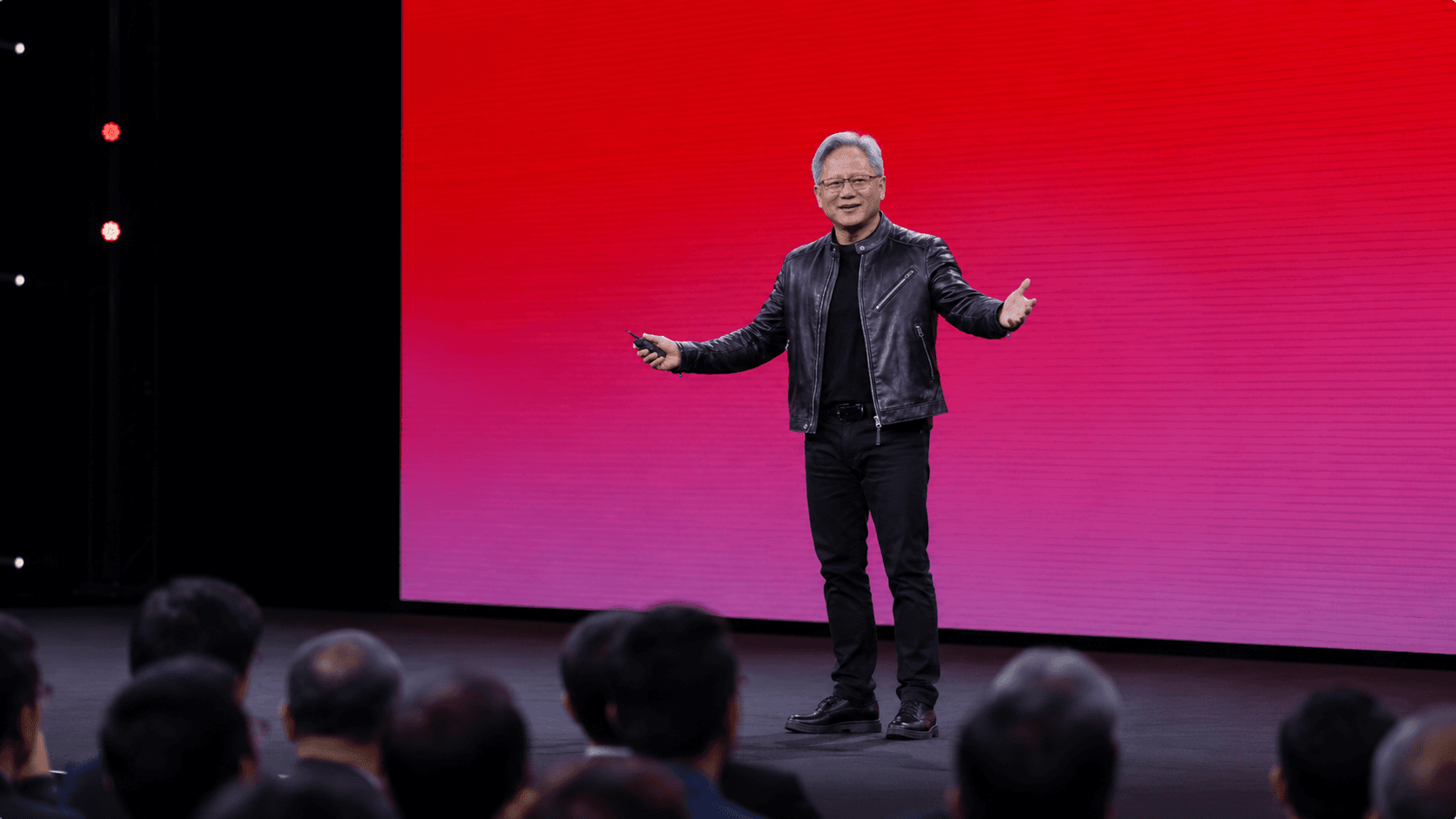
Nvidia CEO Jensen Huang told the Milken Institute on Monday night that AI is 'creating an enormous number of jobs,' rejecting the view that the technology Nvidia sells the picks and shovels for will gut American employment. The remarks, made in conversation with MSNBC's Becky Quick, arrive as reputable financial and academic organizations forecast that as much as 15% of US jobs will be eliminated over the next several years because of AI. Huang's counter: AI is the United States' 'best opportunity to re-industrialize' itself.
The framing matters because Nvidia is the single most exposed company to that re-industrialization thesis. The new factories Huang invoked are largely AI data centers stuffed with Nvidia hardware, and every argument that AI builds rather than destroys the labor base is also an argument for the buildout that drives Nvidia's revenue. Huang did not pretend otherwise.
Quick pressed him directly on the speed of the shift. 'This is happening so quickly. Is there a bigger dislocation than we've seen in the past that leads to greater inequality? And what do we do about that?' she asked. Huang did not engage the inequality question on its own terms. Instead, he argued the premise was wrong.
Key facts
- 01Jensen Huang told the Milken Institute that AI is 'creating an enormous number of jobs' and is the United States' best chance to re-industrialize.
- 02Reputable financial and academic forecasts suggest as much as 15% of US jobs will be eliminated over the next several years due to AI.
- 03MSNBC's Becky Quick pressed Huang on whether AI's speed creates dislocation 'bigger…than we've seen in the past' and worsens inequality.
- 04Huang argued doomers conflate task automation with job replacement, saying critics 'misunderstand that the purpose of a job and the task of a job are related' but not identical.
His reasoning rested on a distinction between tasks and jobs. People who assume AI will erase entire roles 'misunderstand that the purpose of a job and the task of a job are related' but not the same thing, Huang said. A discrete task inside a role can be automated, in his telling, while the broader function the employee serves continues. It is the same argument software vendors have made about every prior wave of automation, now applied to white-collar work.
“Huang's pitch lands against forecasts from reputable financial and academic organizations that as much as 15% of US jobs will be eliminated over the next several years.”— Jaeden Schafer
Huang was sharper on the doom side of the discourse. 'My greatest concern is that we scare…people—all the people that we're telling these science fiction stories to, to the point where AI is so unpopular in the United States, or people are so afraid of it, that they don't actually engage it,' he said. The irony, which Huang did not name, is that the loudest doom messaging has come from inside the AI industry itself, where existential-risk talk doubles as marketing for capabilities the products do not yet have.
The 15% figure is the number that hangs over the conversation. It is not Huang's number, and he did not contest it directly, but it is the ambient forecast against which his optimism has to land. If even half of that materializes inside a few years, the dislocation question Quick raised becomes the central economic story of the decade, regardless of how many factory jobs the AI buildout creates on the other side.
Nvidia's own posture is also a tell. The company has spent the past year backing vertical AI players from legal to robotics, and Huang has used nearly every public appearance to argue that more compute, more agents, and more deployment are coming. Earlier coverage of Nvidia's NemoClaw agent stack and its investment in legal AI startup Legora at a $5.6B valuation tracks the same message: the bottleneck is not demand for AI labor, it is supply of AI infrastructure.
What Huang did not address is the timing mismatch. AI factories take years to build and staff. Task-level automation inside knowledge work is shipping now, quarter by quarter, inside tools employees already use. Even if the long-run jobs picture is neutral or positive, the gap between displacement and replacement is where the political and labor pressure will sit, and that gap is not something a hardware CEO is positioned to close.
Huang's optimism is also doing real work for the industry's narrative at a moment when the receipts are mixed. Forecasts of mass white-collar disruption keep landing in the same week as earnings calls where AI revenue is concentrated in a handful of vendors and infrastructure providers, Nvidia chief among them. Telling workers not to be afraid is easier when your customers are the ones automating their work.
The Milken appearance will not settle the jobs debate, and Huang did not try to settle it. He tried to reframe it, away from displacement and toward engagement, and away from inequality and toward industrial capacity. For Nvidia, that reframe is the product. For everyone else, the 15% number is still on the table, and the question Quick asked—what do we do about that—still does not have an answer.

Working on something we should cover, or seeing a story we missed? Send leads, documents, or feedback to hello@aichatdaily.com. For sensitive tips, see our secure tips page for Signal and PGP options.
Spotted an error? Email hello@aichatdaily.com with the URL and the issue, or read our full corrections policy.